
- Website Marketing for AI Search: Optimize for Citations
- How to optimize a website for AI search before you touch content
- Step 1: Restructure pages so passages can be extracted
- Step 2: Make your brand and authors machine-readable
- Step 3: Extend your credibility beyond your own domain
- How to measure AI search performance
- Quick audit: where to start on your existing site
- What the website is now for
Website Marketing for AI Search: Optimize for Citations
During the first four months of 2026, 68% of U.S. Google searches ended without a click, up from 60% two years prior, according to SparkToro research analyzed by Search Engine Land. When AI Overviews appear, click-through rates drop by nearly 60%. Website marketing for AI search is no longer a forward-looking experiment. It's the current condition.
The mechanism behind this shift determines what good optimization actually looks like. AI systems Google AI Overviews, ChatGPT, Perplexity retrieve candidate pages, isolate the passages that best answer the query, and cite the strongest match. As HubSpot noted this month, answer engines don't rank pages so much as read them. Your page either gets cited or it doesn't.
That changes the core question for any site owner. It's no longer only "how do we rank?" It's "are we a source AI systems trust, extract, and cite?"
There's financial logic behind prioritizing that question. Visitors arriving from AI-powered search convert at 4.4 times the rate of traditional search visitors, according to MarTech. Fewer referrals, but far more intentional ones. And AI-referred sessions grew 527% between January and May 2025 alone, per Previsible's 2025 AI Traffic Report cited by HubSpot.
One framing note before diving in: traditional SEO is not dead. Branded searches, local queries, and high-intent transactional searches still generate meaningful click traffic. The goal is to layer answer engine optimization (AEO) on top of existing SEO foundations, not discard them.
This guide covers what a content team can actually control: technical accessibility for AI crawlers, page structure that makes passages extractable, trust and entity signals that tell AI systems your brand is worth naming, and off-site credibility. It closes with a measurement framework and a 90-day audit sequence.
How to optimize a website for AI search before you touch content
No content work matters if AI crawlers can't read the page in the first place.
A 2025 Search Engine Land investigation found that 63% of ChatGPT bot visits leave pages immediately HTTP errors, slow load times, CAPTCHA blocks, or robots.txt settings are the usual culprits, as cited by HubSpot. Nearly half of those visits begin in "reading mode," meaning the crawler attempts to extract text directly rather than interact with a JavaScript-rendered interface. If the answer text only appears after a user interaction or loads late via JavaScript, the crawler may never see it. Pages that depend heavily on client-side rendering are structurally at risk.
Three checks to run before touching content:
- Audit
robots.txtand crawler permissions. Confirm that major AI user agents Googlebot, GPTBot, PerplexityBot are not inadvertently blocked. Check for overly broadDisallowrules that sweep up content pages. (MarTech) - Submit an updated XML sitemap and verify critical pages are indexed. AI systems retrieve pages from their indexes first. A page that isn't indexed doesn't exist to these systems. (MarTech)
- Fix HTTP errors and test page load time on priority pages. Slow responses and broken links are among the most common reasons crawlers abandon visits before reading any content. Run broken link audits regularly. (MarTech)
Once these are clear, content optimization has a surface to work on.
Step 1: Restructure pages so passages can be extracted
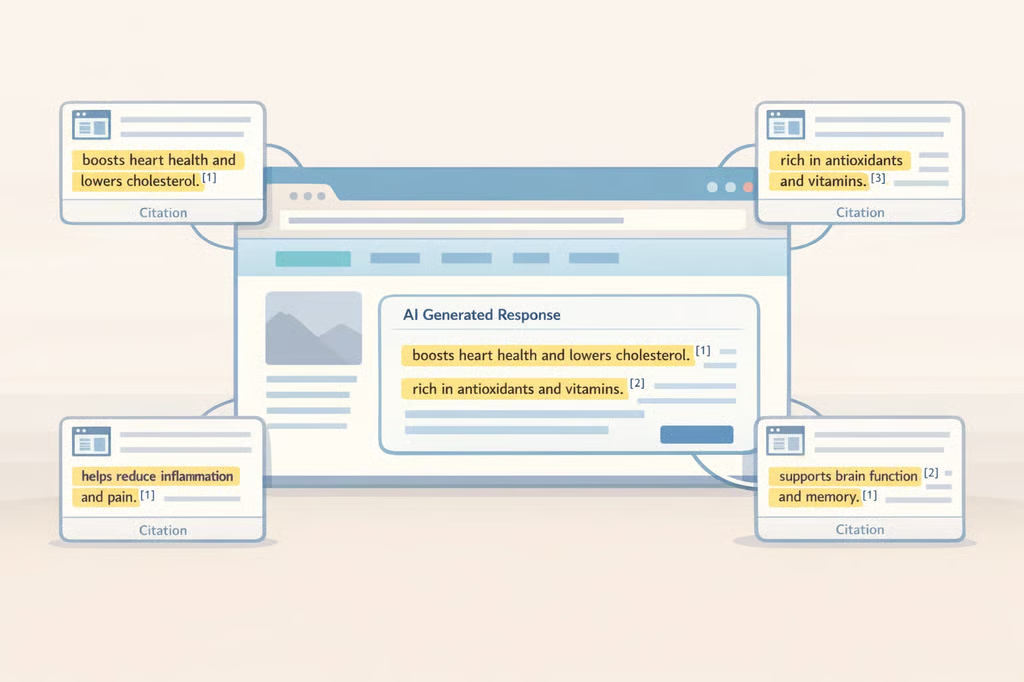
AI engines split pages into self-contained chunks paragraphs, list items, table rows, definition boxes and score each one independently against the query. The chunk that most directly answers the question gets cited. The rest of the page is largely irrelevant to that specific decision.
Here's what citation-ready structure actually looks like in practice.
Use sequential, question-led headings. Logical heading structures increase citation odds by 2.8 times, per the AirOps 2026 State of AI Search report cited by HubSpot. Question-led headings "What is answer engine optimization?" rather than "Overview" let the engine match the heading to a query before reading the passage beneath it.
Lead with the answer, then support it. A Search Engine Land analysis found that 44% of ChatGPT citations come from the first 30% of a page, and cited passages were nearly twice as likely to use definitive language ("X is," "X works by") rather than hedged framing, as cited by HubSpot. Put the key fact first. Trim qualifiers that dilute it.
Make each paragraph self-contained. Aim for one idea per paragraph, stated plainly without requiring the reader to reference what came before. Avoid pronouns that point back to earlier text "this approach," "that method" because they break the passage the moment it's lifted from context. (HubSpot) Treat this as a writing guideline, not a rigid rule: the goal is passages that hold their meaning when extracted, not artificially truncated prose.
A writing illustration not a research finding of what this looks like:
Context-dependent and hedged:
"This approach, as described above, can be helpful in many cases. It might improve your visibility, though results will vary depending on a number of factors."
Standalone and direct:
"Answer engine optimization structures content so AI systems can extract and cite individual passages. Pages with sequential headings, inverted-pyramid paragraphs, and explicit Q&A blocks tend to be easier for engines to cite than unstructured prose."
Three format types that support extraction:
- Explicit Q&A blocks. Question-and-answer pairs are among the easiest structures for engines to cite verbatim. Add FAQPage schema so each pair is machine-readable rather than inferred from prose. FAQPage schema is most appropriate where readers genuinely have distinct questions not as a formatting trick applied to every page. (HubSpot)
- Comparison tables. Tables function as pre-packaged summaries an engine can lift whole. Use them where rows and columns naturally map to a direct answer: specs, feature comparisons, definitions. (HubSpot)
- Internal links from topic pages to specific answers. Internal linking is a measurable lever in AEO and a foundation of durable AI Overview performance, per HubSpot. It helps engines understand topical relationships across a site and strengthens the authority of individual pages in context. Link from high-level topic pages to the specific passages that answer narrower queries.
One structural warning: don't optimize format before substance. The prior question is whether the page would genuinely satisfy the searcher's intent even without an AI summary. A well-formatted shallow page is still a weak citation candidate. (HubSpot)
Step 2: Make your brand and authors machine-readable
Structured content is necessary, not sufficient. AI engines also evaluate who is behind the content and whether that source is credible the identity layer of AEO, which maps directly to Google's E-E-A-T framework (Experience, Expertise, Authoritativeness, Trust).
E-E-A-T is not a direct ranking factor. It's a framework Google uses to train human quality raters, and its algorithms reward signals that correlate with it. AI engines apply comparable criteria when selecting citations: they favor sites with real organizations, named authors, dated content, and verifiable external presence. (OptiSEOn)
Trust is the most important of the four components in Google's own documentation. The most common trust failures are elementary: no About page, no author bios, no physical address or contact information. These are fixable within days. (OptiSEOn)
Schema markup translates visible trust signals into machine-readable ones. Three types to implement, in priority order:
- Organization schema Identifies the brand behind the content so citations name the right source. Use a single canonical brand name across every page. Inconsistent naming fragments entity recognition over time. Basic implementation requires no developer on most CMS platforms. (HubSpot)
- Article schema Marks the headline, author, and publish date on each piece so engines can identify primary content and authorship. Custom implementations typically need developer support. (HubSpot)
- Person schema Links content to a named expert using
sameAsto connect the author's profile to an external identity such as LinkedIn. This makes authorship explicit and machine-readable rather than a floating byline. Bio page copy is an editorial task; the schema implementation is minor dev work. (HubSpot)
For reference on adoption rates across schema types, Google and Schema.org published a public dataset of schema usage statistics across millions of domains, updated monthly. (Schema.org)
Editorial steps any content team can complete without developer involvement:
- Publish a substantive About page naming the organization, its purpose, and the people behind it
- Add author bios with credentials and role to every piece of content
- Name human editors and reviewers explicitly; for AI-assisted content, add a note identifying who fact-checked the piece (HubSpot)
- Include publication and last-updated dates on all content Perplexity in particular favors recently dated material, per OptiSEOn, though that finding comes from audit experience rather than a controlled study
- Add a physical address or verifiable contact method; its absence is a deficiency machines register as a trust signal
Foundational trust markers can often be in place within 30 days. Building genuine authority through external recognition takes 6–12 months minimum. No shortcut exists for the second part. (OptiSEOn)
Step 3: Extend your credibility beyond your own domain
On-site optimization establishes your site as a capable source. Off-site signals help AI systems decide whether your brand is worth trusting in the first place.
Roughly 85% of brand mentions that AI systems draw on originate from third-party pages rather than owned domains, per the AirOps 2026 State of AI Search report cited by HubSpot. Domains listed on multiple review platforms earn three times more ChatGPT citations than those without a review presence, per SE Ranking findings cited in the same source. Nearly half of all AI citations 48% come from community platforms: forums, Q&A sites, and review aggregators. None of these are assets you own, but all are surfaces you can actively cultivate.
Deciding which platforms to prioritize is itself a strategic question. The useful filter: where does your audience actually ask questions that your content answers? A SaaS company's buyers use different forums than a local services business's customers. Start with two or three platforms where your specific audience is already active, rather than spreading thin across every review site.
Practical moves:
- Audit brand listings on relevant review platforms for accuracy name, description, category, and links should match your site's canonical information
- Participate substantively in community platforms where your audience asks questions; answers written in clear, standalone, definitive language are more likely to be indexed and cited
- Earn mentions from credible third-party publications through original research or proprietary data; adding statistics and credible citations to your own content can increase source visibility in AI-generated responses by up to 40%, per a Princeton/ACM SIGKDD study cited by HubSpot
Freshness: the signal most teams underestimate
AI-cited content is on average 25.7% fresher than content in traditional organic Google results, per an Ahrefs analysis cited by HubSpot. More specifically: 76.4% of ChatGPT's top 1,000 cited pages had been updated within the previous 30 days, and pages that go more than a quarter without an update are three times more likely to lose citations entirely, per the AirOps 2026 report cited in the same source.
A quarterly refresh cadence updating statistics, examples, and publication dates on high-value pages can often be enough to maintain the freshness signal. Full rewrites are rarely necessary.
How to measure AI search performance
Traffic volume is no longer the primary indicator of whether website marketing is working. Citation frequency is.
Four methods that give a more accurate picture:
- Manual prompt tracking. Run the queries your target audience is likely to ask in Google AI Overviews, ChatGPT, and Perplexity. Note whether your brand or content appears, how it's characterized, and whether the citation is linked. Do this for 10–20 priority queries each month.
- Referral segmentation in analytics. Segment direct and referral traffic by source. AI platforms increasingly appear as referrers as citation volume grows. Track session counts, pages per session, and conversion rate for this segment separately.
- Mention quality logging. When your brand appears in an AI-generated answer, log whether the name is accurate, the link correct, and the representation fair. Inaccurate brand characterization in AI answers is a reputational problem that requires off-site correction, not on-site fixes.
- Assisted conversion tracking. A visitor may arrive from an AI citation, not convert immediately, and return later through another channel. Set up assisted conversion reporting in your analytics platform to capture this pattern. (HubSpot)
These metrics are imperfect AI citation tracking has no industry-standard tooling yet but they're more useful than organic traffic volume for assessing whether AEO work is paying off.
Quick audit: where to start on your existing site
Week 1–2 Technical access (dev task):
- Confirm AI crawlers are not blocked in
robots.txt - Submit XML sitemap; verify high-value pages are indexed
- Fix HTTP errors and page speed issues on priority pages
Week 3–4 Trust signals (editorial task):
- Publish or update the About page with real organizational detail
- Add author bios with credentials and review credits to all content
- Add publication and last-updated dates across the site
- Add contact information and physical address
Month 2 Page structure (editorial task):
- Identify five to ten pages by business value, not just traffic volume commercial pages that drive pipeline deserve attention alongside high-traffic informational ones
- Rewrite section headings as questions; restructure paragraphs using the inverted pyramid pattern
- Add an explicit Q&A block to each page targeting the two or three questions readers most commonly ask, where a Q&A format genuinely fits
- Implement FAQPage schema on those pages; add Article and Organization schema site-wide
Month 3 Off-site and internal linking (editorial + dev):
- Audit brand listings on review platforms for consistency
- Add internal links from topic-level pages to specific passage-level answers
- Identify two or three community platforms where your audience asks questions in your domain and begin contributing
A site that works through this sequence can address many of the structural, trust, and accessibility gaps that prevent AI citation though results vary considerably by industry, existing domain authority, and competitive landscape, per OptiSEOn. The off-site authority work extends well beyond 90 days; building genuine external recognition takes 6–12 months. The on-site foundation, though, is achievable quickly.
What the website is now for
The scale of this shift is not hypothetical. Google AI Mode surpassed 1 billion monthly users and was more than doubling query volume each quarter as of Google I/O 2026, per Search Engine Land. Meanwhile, 58% of marketers are already optimizing for answer engines, per HubSpot's 2026 State of AEO Report.
A website in the AI search era serves three functions at once. It's a source document structured so AI systems can extract and cite specific passages. It's a trusted entity with machine-readable signals that confirm who is behind the content. And it's a conversion touchpoint, because the visitors who arrive via AI citation convert at 4.4 times the rate of traditional search visitors, per MarTech, making each referral disproportionately valuable even when volume is lower.
Several questions remain genuinely unresolved. The research doesn't yet clearly distinguish how optimization should differ across Google AI Overviews, ChatGPT, Perplexity, and Gemini. The link between AEO tactics and downstream revenue is real but not yet well-documented with rigorous attribution. Whether these principles hold equally across SaaS, ecommerce, local businesses, and B2B services is still an open question.
What's clear is that the work starts on-site, with accessible pages, extractable passages, and honest trust signals. Much of it requires editorial judgment rather than engineering. That puts the use squarely in the hands of the people writing and managing the content.
