
- Phrases to Soften Work Emails: Where They Help and Where They Don't
- The phrases, organized by function and what that tells you
- Why "please" is the floor, not a lever, and what the experiment found
- Which phrases to soften work emails actually help, by situation
- How power, role, and language background change which phrases belong
- What the research actually settles
Phrases to Soften Work Emails: Where They Help and Where They Don't
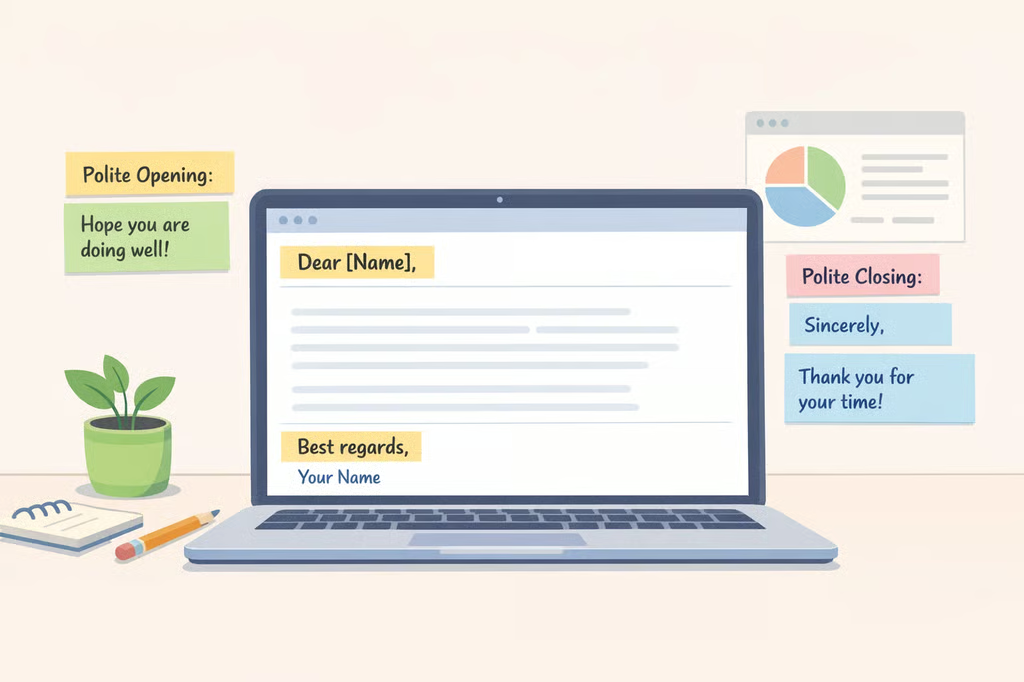
Most workplace email requests draw from a surprisingly short list of phrases to soften work emails. "Please find attached." "Could you." "I hope this email finds you well." "Thank you for your time." "Kindly." "Appreciate if." "Would it be possible to." "Sorry to bother you." "Please let me know." "I'd be grateful if." These aren't personal style flourishes. They're a narrow, recurring vocabulary that professionals across industries and language backgrounds have independently converged on.
Research backs this up. An analysis of 1,148 authentic workplace request emails found that formulaic polite phrasing clusters most heavily in two specific spots: the opening lines and the closing, with the request itself showing far less patterning (Ibérica, June 2024). Across business emails from China, Hong Kong, and the Philippines, sentence-opening "please" alone accounted for 53.3% of all recorded politeness markers, with "please" appearing elsewhere in a sentence adding another 20% on top (Journal of English Education, December 2022).
The argument here is specific: these phrases earn their keep at the opening and closing of an email, and in requests directed upward in the hierarchy. Applying them out of habit throughout the body doesn't reliably improve outcomes. In some situations it produces the opposite of what the sender intended. The more useful question isn't "should I soften this email?" but "where in this email does softening actually do something?"
The phrases, organized by function and what that tells you
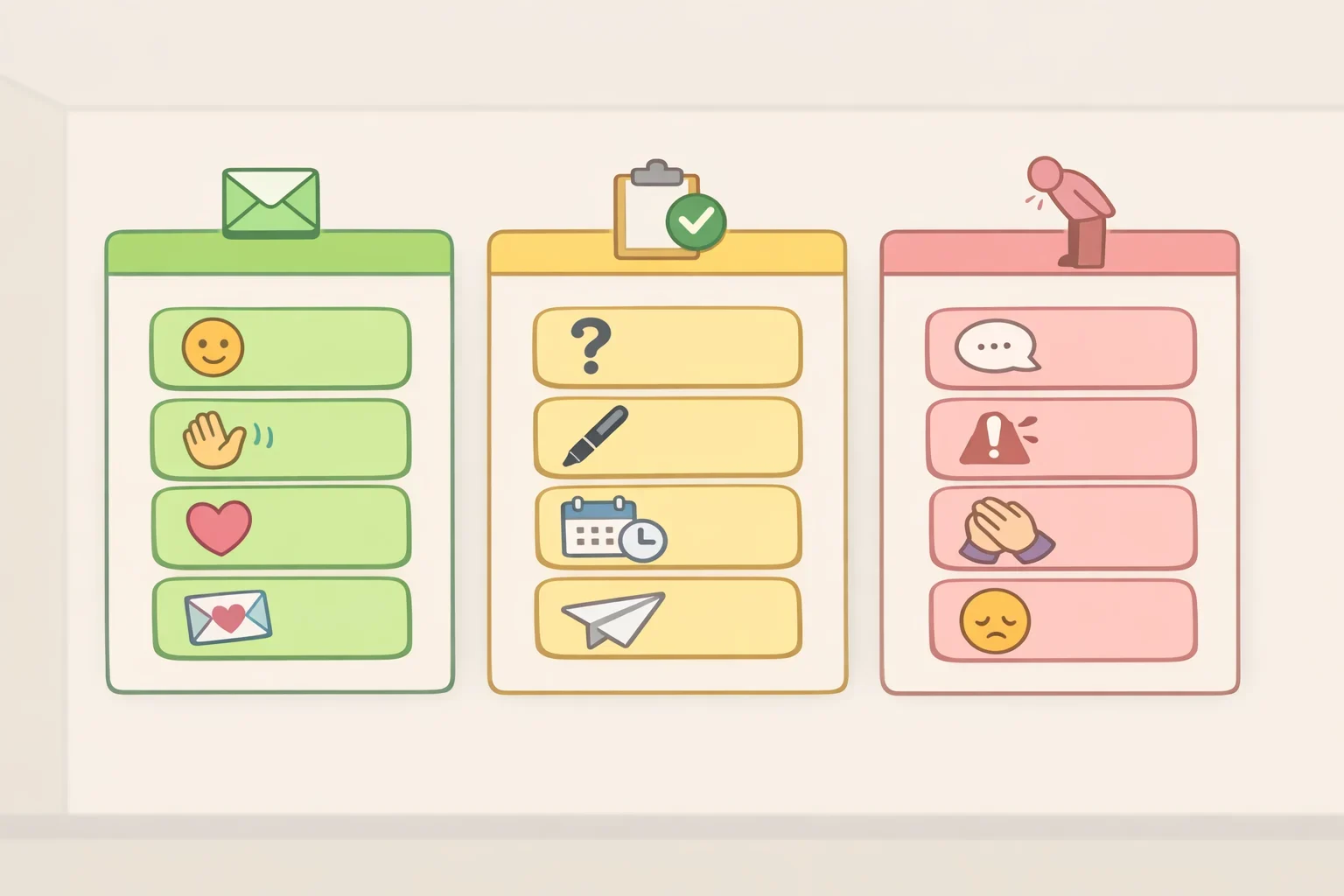
The phrases fall into three functional categories. Treating them as a single undifferentiated list misses why some belong in one part of an email and not another.
Courtesy openers and closers handle relationship maintenance before and after the business of the email: "I hope this email finds you well," "thank you for your time," "I'd be grateful if you could." This is where softening language concentrates. When an AI model was asked to write a professional email, it produced exactly two politeness sentences, one at the opening and one at the close, with nothing in between (Frontiers in Education Research, 2024). That placement reflects where warmth signals carry the most structural weight. The opening signals respect before the ask arrives; the closing restores the relationship after an imposition has been made.
Polite request forms are the mechanism for the ask itself: "please find attached," "please let me know," "could you," "would it be possible to." The "please + imperative" construction is the dominant direct-request pattern in real corporate email, the most common sequence identified across 398 internal emails from a multilingual insurance company (Journal of English as a Lingua Franca, September 2022). Modal forms like "could you" and "would it be possible to" reframe a directive as a question, implying the recipient has a choice. In the same corpus, lower-power employees leaned toward these indirect forms, while higher-power staff tended toward the more direct "please + verb" construction.
Deferential and apologetic markers "kindly," "appreciate if," "sorry to bother you" acknowledge explicitly that the request imposes on someone's time. They appear consistently in cross-cultural business email, particularly in correspondence from Hong Kong alongside "please" (Journal of English Education, December 2022). They matter most when writing to someone of equal or higher standing. When they appear in a senior-to-junior exchange, they can read as incongruent with the relationship rather than courteous though that's an inference from the power dynamics the corpus describes, not a finding the studies test directly.
A calibration note on the frequency data: the three-country email sample is small, ten emails per market. The patterns point in consistent directions and align with larger corpora, but they're useful as directional evidence, not universal rankings.
Why "please" is the floor, not a lever, and what the experiment found
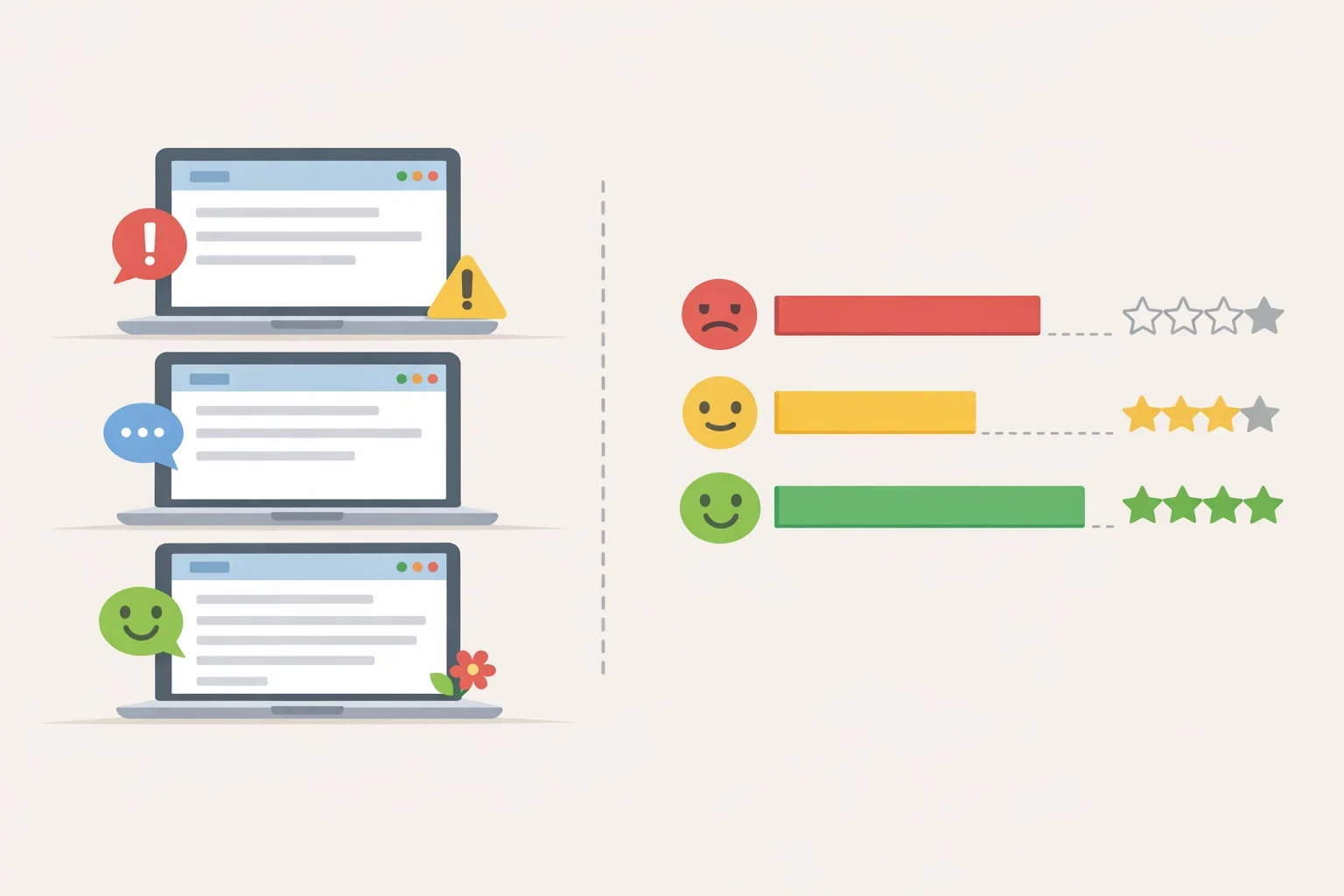
The intuitive assumption about polite phrases for work emails is that more softening means better reception. The evidence is more complicated.
On "please" specifically: researchers analyzing the multinational insurance corpus found that "please + imperative" has become a standard requesting routine in written workplace English, particularly British English, rather than a meaningful mitigator of how demanding a request feels (Journal of English as a Lingua Franca, September 2022). Its presence doesn't noticeably reduce the imposition; its absence, though, risks the message reading as curt. That's a different function than most writers assume. "Please" marks a request as professional rather than rude. Swapping it for "kindly" or stacking both into the same sentence doesn't compound the softening effect. It just adds words.
A controlled experiment with 251 Dutch and British participants tested the same email request in four versions, varying the degree of politeness modification and whether the sender appeared to be a native or non-native English speaker (Journal of Pragmatics, December 2022). The expected finding held: emails with fewer softening phrases made senders seem more bossy across the board.
The unexpected finding cuts against standard business email etiquette advice. When the sender appeared to be a non-native English speaker, less politeness modification actually increased perceived authority (mean score 4.73 vs. 4.14 on the more polite version) and produced significantly higher willingness to comply with the request. For native English speakers, dropping softeners hurt perceived competence specifically, not overall likability. The study's own conclusion: "the idea that the use of less politeness in requests may lead to worse evaluations receives little empirical support." The effects were real in specific dimensions, but not the sweeping communication failure that etiquette guides typically imply.
One further detail from the experiment worth noting: British readers rated all four email versions as more polite and more appropriate than Dutch readers did, regardless of how much softening language the email contained. The phrases don't travel unmodified across reader expectations. Politeness isn't purely in the words.
Which phrases to soften work emails actually help, by situation
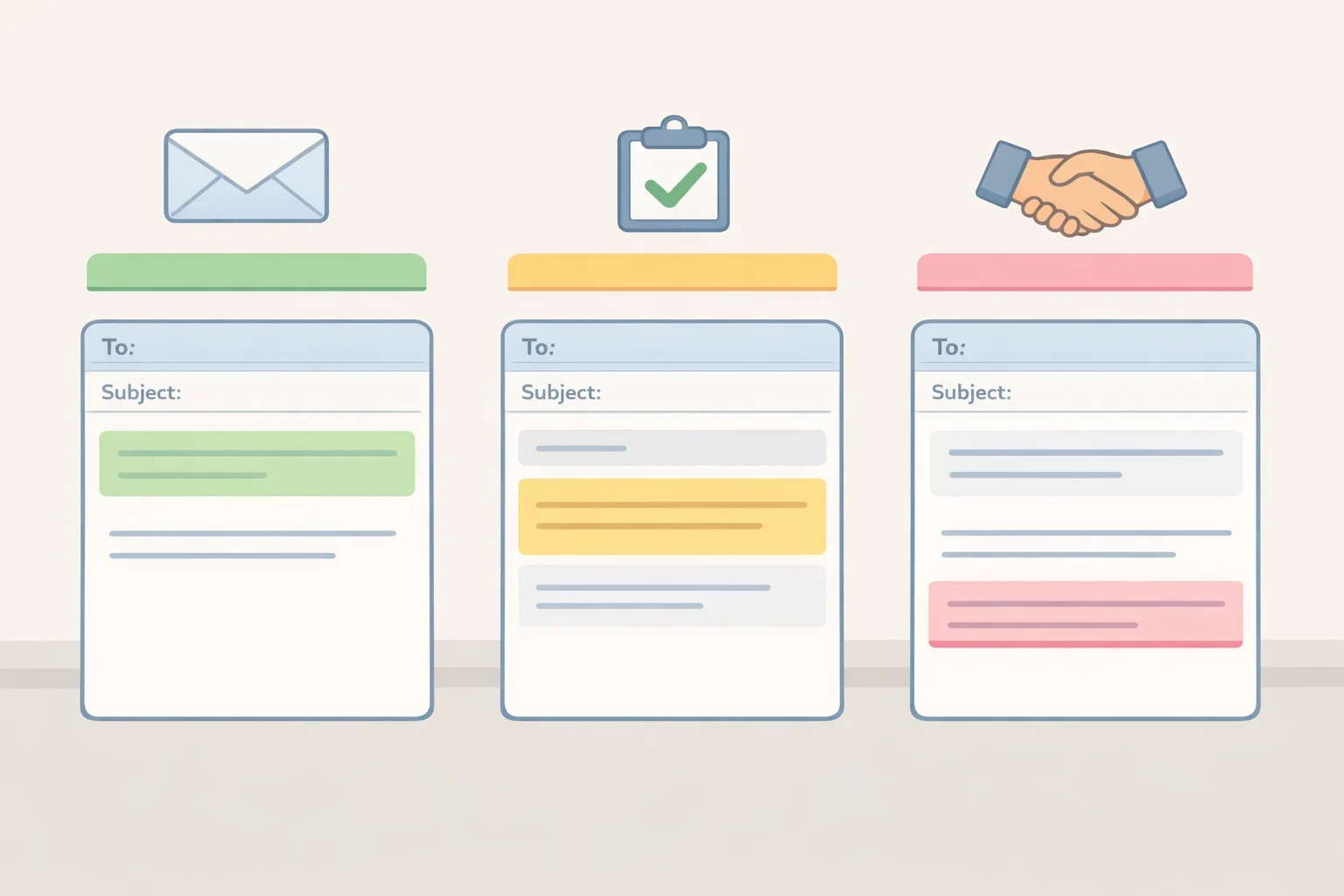
The research identifies where softening language earns its place. Here's how that maps onto five common scenarios.
Upward ask. The full toolkit applies here. Open with a genuine one-line acknowledgment "I hope you had a good trip" outperforms the autopilot "I hope this email finds you well" frame the request with a modal ("Could you share your thoughts on the attached?"), and close with brief thanks. What misfires: stacking multiple hedges into the request itself ("I was just wondering if it might be possible to perhaps.."). That reads as lacking confidence rather than projecting deference.
Peer follow-up. The relationship is horizontal, so the framing shifts. A direct opener is fine. "Following up on the Q3 numbers" doesn't need a warmth buffer. The closer is where a softener earns its place: "Let me know if you need anything from my end." What to avoid: the apologetic opener ("Sorry to bother you again") when the follow-up is entirely reasonable. It creates a one-down dynamic that doesn't serve either party.
Downward deadline request. The corpus data is clear that high-power senders in this study used direct strategies most of the time (Journal of English as a Lingua Franca, September 2022). "Please send the budget breakdown by Friday" fits the role. "I was wondering if you might be able to get that to me by Friday?" signals incongruence with it. The closer can still carry warmth ("Thanks in advance") without softening the ask itself.
Apology for interruption or delay. This is where deferential markers like "sorry to bother you" or "apologies for the late reply" do legitimate work, regardless of hierarchy. They acknowledge the imposition before the ask lands. One line is enough. Extending it across two or three sentences tips into excessive hedging that draws more attention to the disruption than it defuses.
Attachment or closing line. "Please find attached" remains the standard, and the research supports its use as a conventional signal rather than a meaningful courtesy. It marks the message as professional. Substituting "kindly find attached" doesn't add warmth; it sounds slightly archaic. "I've attached the report below" is a cleaner alternative if the formula has started to feel stale.
The pattern across all five scenarios: invest the softening language at the opening and closing, keep the request itself clear, and calibrate the level of indirectness to the actual power relationship rather than applying a uniform politeness setting to everything you send.
How power, role, and language background change which phrases belong
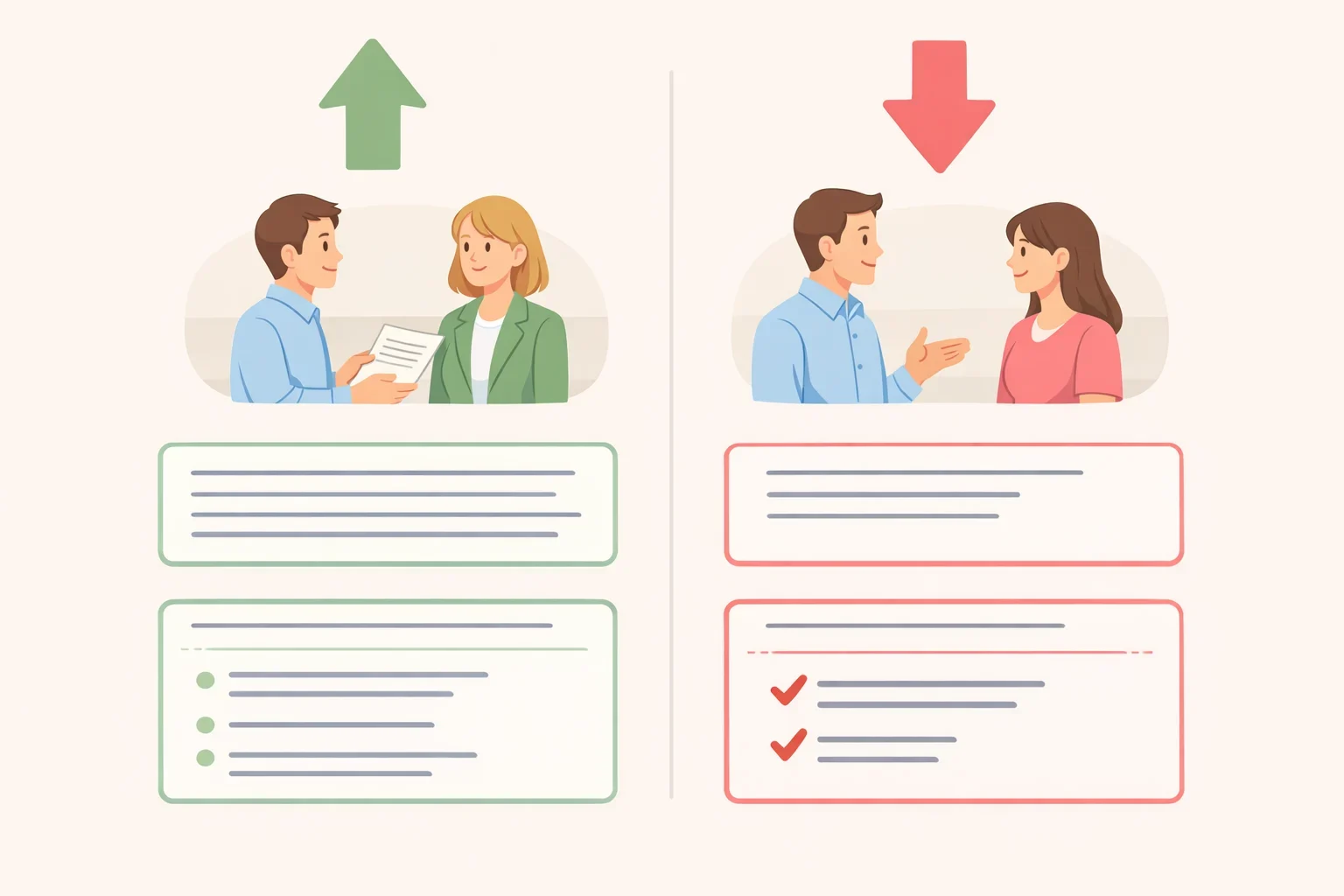
The same construction that reads as appropriately professional from a junior employee can read as oddly tentative from a senior manager, and real-world email behavior reflects this.
In the 398-email corporate corpus, 62% of requests were direct no elaborate hedging, just the ask (Journal of English as a Lingua Franca, September 2022). That figure pushes back against any assumption that professional email defaults to heavy politeness. Among native English-speaking staff specifically, high-power employees used significantly more direct strategies than lower-power employees. Junior staff leaned toward indirect forms: modals, hedges, qualifiers. Cultural background added further variation staff whose first language was Hebrew used direct request strategies 98% of the time, while other groups showed markedly different patterns.
The contrast is clearest with a concrete example:
- Version A (upward request): "Could you share the Q2 report when you have a moment? I'd really appreciate it."
- Version B (downward request): "Please send the Q2 report by Thursday."
For a junior employee writing to a manager, Version A is appropriate. For a senior manager writing to a direct report, it registers as incongruent with the role. Neither version is universally correct the question is which one matches the actual power relationship and the recipient's expectations.
Non-native English speakers face a distinct challenge in this calculus. The Journal of Pragmatics study found that L2 speakers tend to underuse politeness markers relative to native speakers, not out of deliberate bluntness, but because deploying these phrases appropriately requires tacit knowledge of when they're expected, when they're redundant, and when they tip into sounding formulaic (Journal of Pragmatics, December 2022). The bossiness penalty for low-softening emails applied regardless of sender background in that experiment, so the floor still matters. But the data suggests L2 writers aren't penalized as broadly as standard etiquette advice implies. The safer middle ground: a conventional opener, a clear and unambiguous request, no stacked softeners, a brief expression of gratitude at the close.
What the research actually settles
None of this is an argument against using professional email phrases. It's an argument against using them indiscriminately.
The opening and closing are where these phrases move the reader, and that's where they concentrate in real email corpora (Ibérica, June 2024). A genuine opener and a warm close do more to shape how a message lands than loading the request itself with qualifiers.
The bossiness floor is real but narrow. Dropping softeners entirely costs something. Adding more of them beyond that threshold buys very little and the experiment's own finding was that less politeness modification produced worse evaluations on exactly one dimension out of several tested (Journal of Pragmatics, December 2022).
What that leaves is a fairly practical conclusion for anyone writing across teams or cultures: the phrase that reads as appropriately deferential from a junior employee in London may read as incongruent from a senior manager, and may land differently still with a Dutch reader than a British one. Business email etiquette advice typically flattens all of that into a single set of rules. The research doesn't support the flattening. Choose deliberately, calibrate to the relationship, and save the full softening toolkit for the situations upward requests, cross-cultural correspondence, large asks where it actually does structural work.
