

Monumental raises $32M as Khosla Ventures backs its bricklaying robots now it has to prove the economics work
Dutch construction robotics startup Monumental has closed a $32M round led by Khosla Ventures, bringing total funding to $57 million after a $25 million raise in early 2024, Fortune reported today. The company builds fleets of compact, electric, self-driving bricklaying robots that deploy on real construction sites across Europe. What the raise does not come with is any published evidence that the economics work at scale. That is the question contractors and investors will now be watching.
The 2024 round, led by Plural and Hummingbird with participation from Northzone, Foundamental, NP-Hard Ventures, and Material Ventures, was targeted at manufacturing scale, engineering headcount, and expanding robot deployments across Europe, according to TechCrunch. Khosla's entry marks a step up in investor profile. It does not, on its own, resolve the harder question of whether contracted pilots can become repeatable commercial deployments.
The construction sector provides the commercial rationale. U.S. construction output alone runs at roughly $2 trillion annually, according to TechCrunch, and the labor problem Monumental is selling into is real enough that contractors have been willing to run tests and maintain relationships.
What Monumental's bricklaying robots actually do
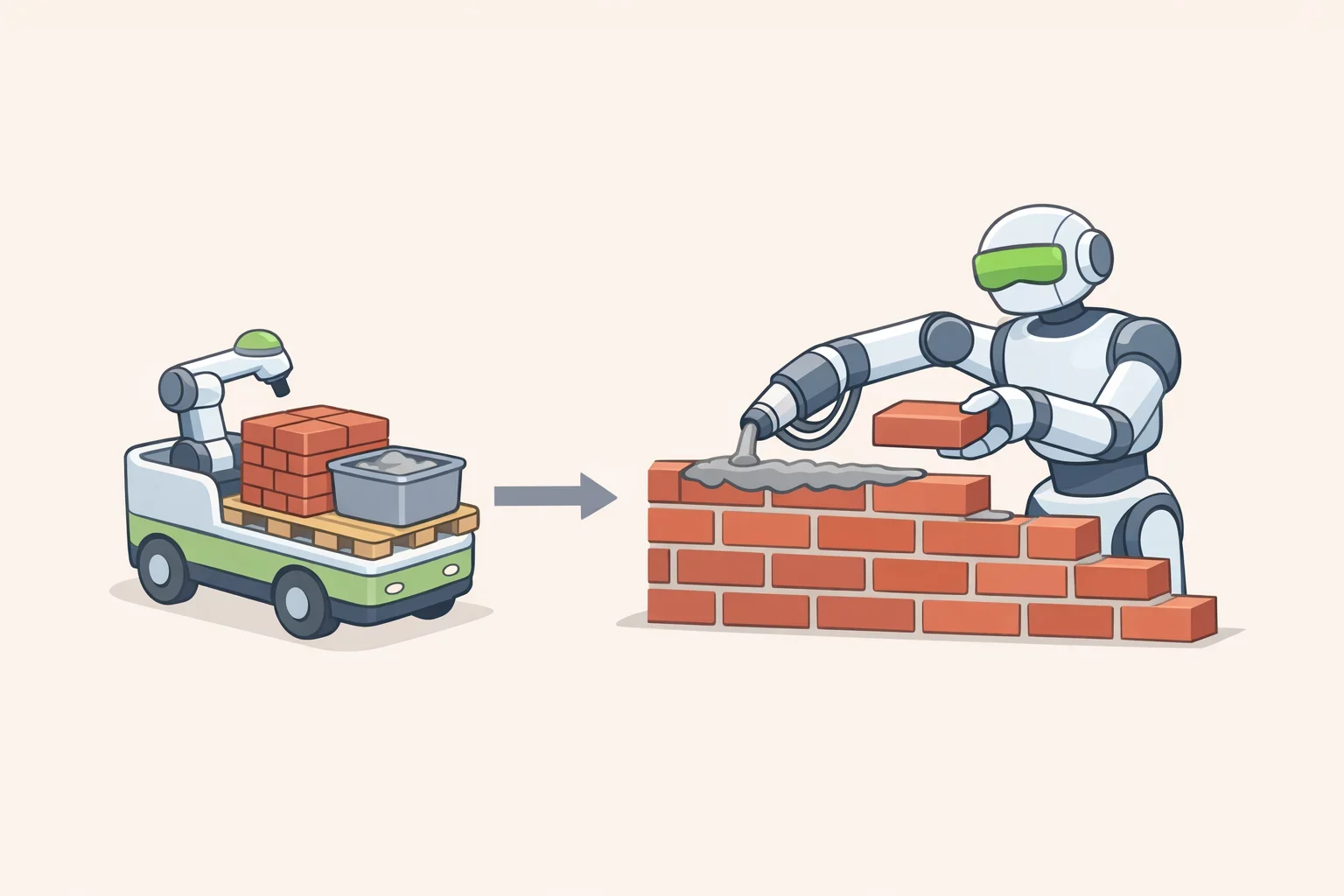
The system works in two stages. An autonomous cart handles heavy material transport, the most physically punishing part of the job, while a second robot spreads liquid mortar and places individual bricks, TechCrunch reported in early 2024. The company describes the combination as blending robotic efficiency with human expertise on the same site, not replacing crews outright.
Bricklaying is a structured, repetitive task with clear geometric constraints, which helps explain why it has attracted automation attempts. Monumental focuses specifically on traditional red clay brick, separating it from rivals like Hadrian X, which targets large concrete masonry blocks, according to TechCrunch. The two companies are not competing for the same job sites.
By the time of its 2024 raise, Monumental had completed field pilots in the Netherlands, including the 15-meter exterior of a commercial office building, and had established working relationships with 25 contractors across project types including low-income housing, TechCrunch noted. Those pilots showed that contractors see enough promise to run tests. That is meaningful. It is not the same as showing the unit economics work when a contractor is paying their own money and operating across a full build cycle rather than a demonstration window.
The 2024 capital was also earmarked to expand the range of brick types and construction tasks the robots can handle, as well as grow the engineering team, TechCrunch reported. That framing matters: it signals the product scope was deliberately being broadened at the time of the raise, not treated as finished. Whether the new $32 million goes toward similar priorities or toward pushing existing deployments toward commercial self-sufficiency has not been disclosed.
The verification gap: what the reporting leaves open
Performance assessments available in the cited reporting have rested primarily on company-provided video demonstrations. The TechCrunch reporter who covered the 2024 raise was direct about this: they could not speak to the efficacy of the system beyond video demos. Figures for bricklaying speed under actual site conditions, system uptime across a full build cycle, rework rates, and maintenance burden once robots are operating through weather and material variability are not publicly available.
Speed matching alone does not settle the commercial case. Monumental pitched its robots in early 2024 as capable of laying bricks at a human mason's pace, Fortune reported. But pace equivalence is not the bar contractors set when evaluating a new system. The question they need answered is whether the all-in cost of deploying the robots, capital, maintenance, downtime, and the labor still required on site, undercuts the fully loaded cost of doing the work without them. That calculation has not been made public.
Twenty-five contractor partnerships are a real signal. They indicate contractors see enough promise to engage and maintain contact. But a pilot a contractor participates in is a different thing from a deployment a contractor initiates, pays for, and keeps renewing after the first season shows what breaks. The reporting leaves open whether Monumental has crossed that line with any of its existing partners.
What Monumental raises $32M to prove next

Monumental co-founder and CEO Salar al Khafaji sold his previous company, data visualization firm Silk, to Palantir in 2016, Fortune reported today. A prior institutional exit gives an investor a concrete basis for backing an operator through difficulty, and the difficulty here is not hypothetical. "Most people told me it's a really, really bad idea," al Khafaji told Fortune. In venture, that reception often reads as a signal that the competitive field is thin, not that the problem is unsolvable.
Khosla is not making a single robotics bet. Last year the firm co-led a $105 million seed round for Genesis AI, which is building a general-purpose AI model for robots, TechCrunch reported. Khosla partner Kanu Gulati described that investment as "a big unknown," specifically whether any company will produce a robotics foundation model that generalizes across tasks. Monumental and Genesis sit at different points on the horizon. Monumental is a purpose-built system doing specific work on specific job sites now. Genesis is a long-duration platform bet on what generalizable robotics AI might enable years from now. Backing both is a way of holding positions at different time horizons without one canceling the other.
The scale gap between these investments is worth noting without overstating. Against a robotics field that includes Physical Intelligence, which raised $400 million, and Skild AI, which reached a $4 billion valuation, Monumental's $32 million is a modest number, per TechCrunch. A hardware company with robots on contracted job sites and a narrower capital base carries a different risk profile than a platform play that needs broad industry adoption before it generates its first dollar. Lower burn and existing deployments are not the same as proven economics, but they are a different kind of bet.
The concrete unknowns this round does not resolve

Monumental has done more than many companies at this stage: hardware operating on real sites, relationships with 25 contractors, two institutional raises, and a founder with a prior exit. The 2024 raise bought time to scale hardware manufacturing and expand the contractor base. The 2026 raise extends that runway.
The questions that remain are specific and answerable over the next 12 to 18 months. Do contractors who ran pilots after the 2024 raise keep deploying the robots through full build cycles, on their own budget, without startup support propping up the engagement? Does per-deployment economics hold when maintenance costs, downtime, and real-world material variability are factored in across a full construction season rather than a controlled demo window? And does Monumental's European focus hold, or does the company attempt entry into markets where red clay brick construction is less central to the industry, as Fortune's reporting frames the opportunity?
Progress on scope expansion, specifically whether the robots can handle a broader range of block types and construction tasks than they could at the time of the 2024 raise, will be one visible signal of whether the product is keeping pace with what contractors actually need, as TechCrunch noted. Disclosed unit economics from repeat deployments would be the more definitive one. Construction robotics has produced compelling pilots before. The field's next credibility milestone is a deployment that pencils out, not a better demo.
