

- How to Get Pre-Seed Funding Without a Product: Evidence-First Playbook
- Step 1: Understand what you're actually being evaluated on
- Step 2: How to gather pre-seed evidence before you write a single slide
- Step 3: Pre-seed fundraising storytelling build the pitch around what you've found
- Step 4: Make your ask specific enough to fund
- A note on outliers: what elite raises teach you, and what they don't
- How to get pre-seed funding without a product: what needs to exist before the deck
How to Get Pre-Seed Funding Without a Product: Evidence-First Playbook
To raise pre-seed funding without a product, you need to replace what's missing with the next-best thing: documented evidence that the problem is real, the market is credible, and the economics can eventually work. This guide walks through how to build that case, structure it into a conviction-based pre-seed pitch, and make an ask specific enough to close.
Many pre-seed rounds happen before a product exists, according to Pitch Deck Guide. The conditions have gotten harder, though. As TechCrunch reported this week, large AI seed rounds are making things harder even at the pre-seed stage, with pre-seed founders increasingly held to what would previously have been seed-stage expectations. Pitch Deck Guide claims pre-seed now accounts for over 20% of all venture rounds globally, though that figure comes from a commercial founder guide rather than independent market data and should be treated as directional. Whatever the exact share, the dynamic is real: more founders competing at this stage, with investors expecting more.
Most founders raising pre-seed funding without a product are targeting somewhere between $250K and $2 million, per Pitch Deck Guide. The headline AI raises are outliers, not benchmarks. This guide is for everyone else.
Step 1: Understand what you're actually being evaluated on

The most common misreading of pre-seed is that investors are betting on the founder's personality. Some are. But Hustle Fund, which published its full pre-seed framework earlier this year, starts every investment review with the idea and the problem, not the team. No LinkedIn check, no school lookup. Team evaluation happens only after the idea clears a plausibility test.
That initial review is, by Hustle Fund's own description, "entirely gut-based at the pre-seed stage, no numbers, no tests." That might seem to cut against the evidence-first argument, but it doesn't. Investors make gut calls, but the founder's job is to supply concrete material that shapes that call in their favor. You're not trying to hack an algorithm; you're giving a human enough specific, credible information to feel confident saying yes.
What clears the plausibility test: evidence that a real problem exists, that the market could grow to be meaningful, and that a single customer served well would generate more value than it costs to acquire and keep them, per Hustle Fund. For subscription products, the fund flags payback period specifically: customers need to stick around long enough to return acquisition costs within a few months. If the math doesn't work on one customer, it won't work at scale.
Investors aren't expecting revenue. What they are expecting is evidence that demand exists. Customer conversations, letters of intent, waitlists, documented pain-point validation: all of these count as legitimate signals for pre-seed fundraising, per Pitch Deck Guide. No product raises the weight on everything else, but it doesn't require you to show nothing.
Before fundraising, run this three-part test:
- What specific problem are you solving, and which roles and company types confirmed it hurts through actual conversations? (Names, titles, and paraphrased quotes, not impressions.)
- Why would a single customer pay you more than it costs to serve them, and what's your evidence for that math? (Even rough unit economics built from analogous pricing counts.)
- What does this market look like in three to five years, and what makes you think it's growing rather than flat? (A trend that's already visible elsewhere is stronger than a projection.)
If any of those answers are vague, the pitch isn't ready. Treat the absence of a product as a reason to make everything else sharper, not as an embarrassment to explain away.
Step 2: How to gather pre-seed evidence before you write a single slide
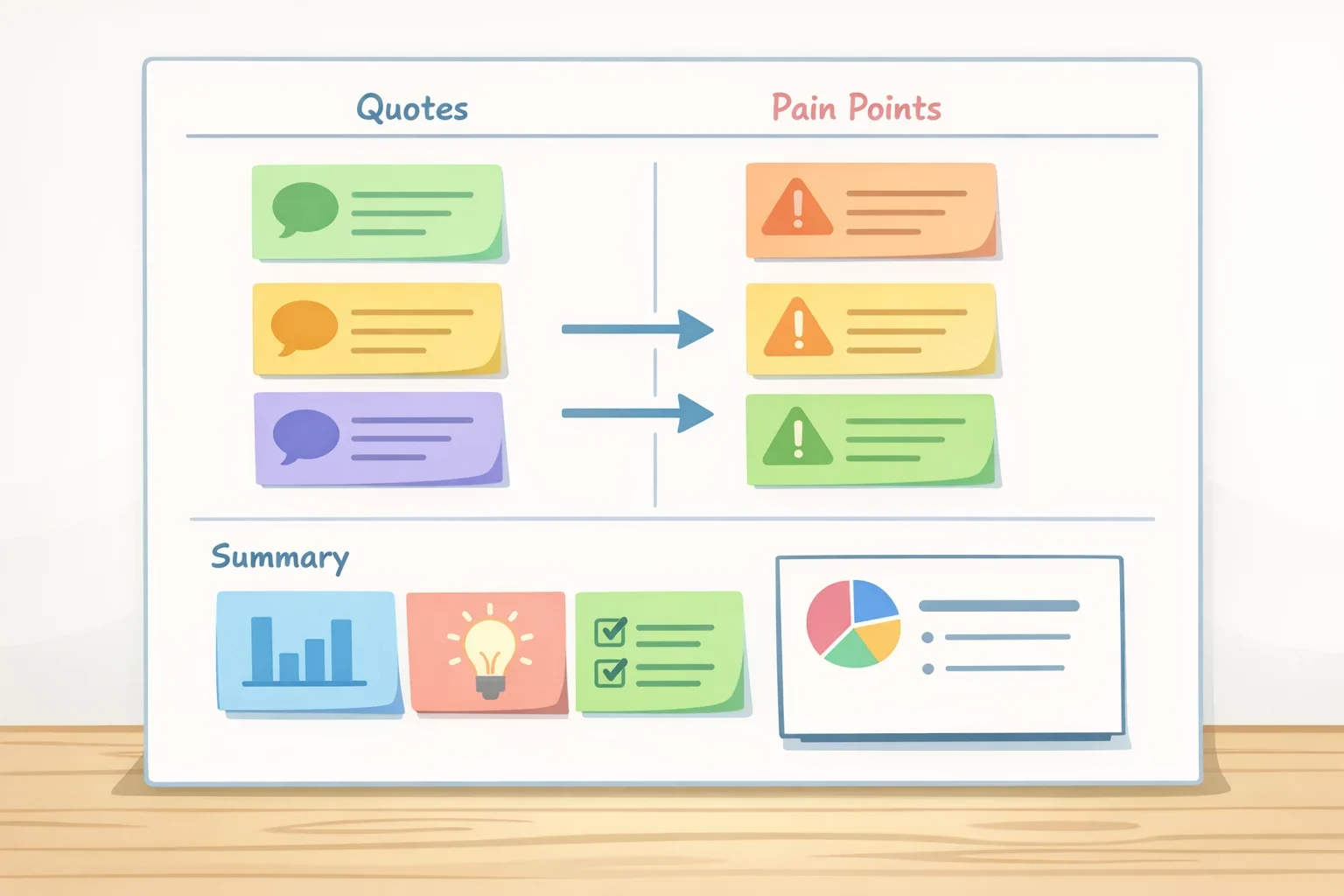
This is where most founders skip ahead too fast. The pitch doesn't create the evidence; it translates evidence that already exists into a form an investor can evaluate. Skipping this step is why so many pre-seed decks feel thin even when the idea is strong.
Customer discovery: the practical mechanics
The goal is 30 to 50 conversations with potential customers before you start drafting a deck. The number matters less than the structure. Useful discovery interviews share a few features: a consistent set of open-ended questions, a defined target customer type (role, company size, industry), and a systematic way of recording responses.
What to ask: how they currently handle the problem you're targeting, how much it costs them in time or money, what they've tried before and why it didn't stick, and whether they'd pay to solve it better. Don't describe your solution. Let them describe the problem.
The output you need for a deck is specific and quotable: who you talked to, what pain they described unprompted, how they currently address it, and the pattern across interviews. "We spoke with 43 operations leads at mid-market logistics companies. Thirty-one of them are manually reconciling carrier invoices in spreadsheets, averaging four hours per week. None of them have found software they'd actually pay for" is a finding. "Customers confirmed strong demand" is noise, and experienced investors will treat it as a red flag.
To find interview targets: LinkedIn search by role and company type, warm intros from your network, relevant Slack communities and industry forums, and cold outreach with a specific, honest ask. Offer something useful in return if you can, a summary of what you're learning, a referral, whatever fits. Response rates are low. Send more outreach than you think you need.
What a letter of intent actually needs to say
A signed letter of intent is Tier 1 evidence. In practice, the most useful LOIs for a pre-seed pitch include the prospective customer's name and company, a description of the problem they want solved, the rough terms they'd consider (price range, contract length), and a statement of intent to become a paying customer once a product is available. It doesn't need to be legally binding. It needs to be specific enough that an investor could call the contact to verify it.
Building market size from the ground up
Pick a specific, defensible customer segment. Estimate how many companies or people fit the profile, using real sources where possible. Assign a realistic annual price per customer, based on what analogous products charge or what your discovery interviews suggest buyers would pay. Multiply. Show your work on the slide. That model, built bottom-up from a real segment, is more persuasive than any TAM figure sourced from a market research report, according to Pitch Deck Guide.
When a waitlist actually helps
A waitlist is Tier 4 evidence, useful as a momentum signal and not much more. It strengthens a pitch when the sign-ups came organically (not from paid ads), when you can show the growth curve, and when you can describe who's on it specifically. A waitlist of 200 unnamed people from a Facebook ad campaign doesn't move the needle. Four hundred sign-ups from a single Reddit post in a niche professional community, with a 30% email open rate, is a different story.
Step 3: Pre-seed fundraising storytelling build the pitch around what you've found
"Storytelling" at pre-seed is not a license to be vague. It means translating a technical or market insight into terms that let an investor make a judgment, even without a product to evaluate. The story is the frame; the evidence you gathered in Step 2 is what holds it together, as TechCrunch noted this week. Separated from each other, neither works.
Andrew Dai, founder of Elorian and a former Google DeepMind researcher, shows this clearly, even though his raise operated well outside typical pre-seed territory. Part of the work behind his company's $55 million seed round at a $300 million pre-seed valuation, before launching a product or generating revenue, was translating a highly technical thesis about gaps in visual AI reasoning into something investors without frontier AI backgrounds could evaluate and believe, as TechCrunch reported this week. The translation wasn't a dumbing-down. It was a clarification, and it functioned as its own form of evidence.
That's the pitch structure: problem proof, why this is unsolved now, why the market is larger than it looks, and what substitutes for product traction. Each element answers the question an investor is already asking.
Pre-traction evidence, ranked by investor credibility (Pitch Deck Guide):
- Tier 1: Direct demand signals. Signed LOIs, committed pilot customers, pre-orders with actual terms
- Tier 2: Validated market insight. Structured customer discovery with specific, quotable findings: "We spoke with 47 potential customers across three segments; 38 named this as their top operational challenge this year"
- Tier 3: Market proxy evidence. Analogous markets, successful adjacent products, documented workarounds that prove the pain is real and unsolved
- Tier 4: Momentum indicators. Waitlist size, inbound interest, press coverage of the problem space
Tier 4 is better than nothing. Tier 1 or Tier 2 is what materially changes the conversation.
One firm warning: "strong market interest" and "positive customer feedback" are not traction. Vague claims on a traction slide are actively worse than a sparse one; they signal a founder who hasn't done the work, or doesn't know what evidence is supposed to look like.
Step 4: Make your ask specific enough to fund
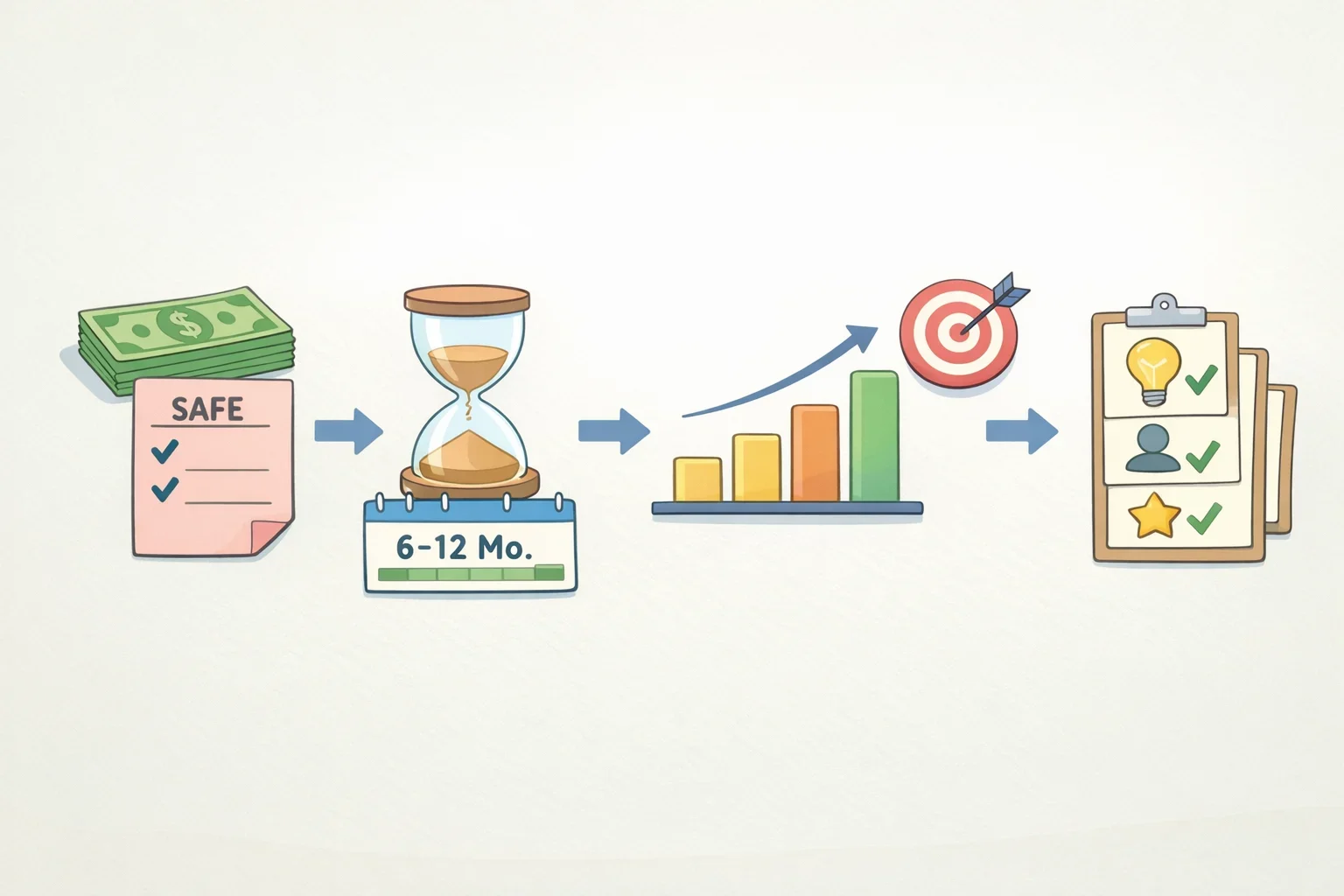
A fundable pre-seed ask covers four things: how much you're raising, on what instrument, for what runway, and toward what specific milestones. The gap between a weak ask and a strong one is concrete. "We're raising a pre-seed round" versus "We're raising $750K on a SAFE with a $5M cap to fund 18 months of runway, reach 10 paying pilot customers, and validate our unit economics before a seed round," per Pitch Deck Guide. The second version tells an investor exactly what they're buying and when they'll know if it worked.
Milestones deserve more thought than founders usually give them. The best ones are externally verifiable and tied directly to the question a seed investor would ask next. "10 paying pilot customers" is a milestone. "Demonstrate product-market fit" is not. The test: if a skeptical investor asked what this round will prove, you should be able to answer in one sentence. Runway isn't a fixed number; tie it to what you need to hit those milestones, then work backward to the dollar amount.
Hustle Fund flags a financial trap that catches many pre-seed pitches: assuming that broken first-product unit economics will be fixed later by upsells or secondary offerings. The core product needs to generate positive per-customer economics on its own. Projecting your way out of that problem with future products raises more red flags than it resolves.
A second warning from the same framework: in its experience, Hustle Fund has seen customer acquisition costs rise 100x, sometimes 1,000x, once larger incumbents notice a market is worth competing for. A milestone plan that only holds at current acquisition costs isn't a plan; it's an assumption. Acknowledging that exposure and explaining how you'd respond reads as preparation, not pessimism.
Skip the five-year revenue projections. Pitch Deck Guide advises against them at pre-seed. Use that space for milestone-based use of funds: what this capital buys, in what sequence, and how you'll verify each step.
A note on outliers: what elite raises teach you, and what they don't
When Andrew Dai raised a $55 million seed round at a $300 million pre-seed valuation before shipping a product or generating revenue, he drew on more than a decade building foundational AI systems, including research that later informed the development of ChatGPT, as TechCrunch reported this week. That track record substituted for execution history in a way that isn't replicable without the underlying credentials. He also turned down higher valuation offers in favor of investors, including Nvidia and Menlo Ventures, whose domain expertise he valued more than a better number on a term sheet. That instinct about investor fit applies at any scale.
What doesn't transfer is the premise. Most pre-seed rounds land between $250K and $2 million, per Pitch Deck Guide. Dai's raise operated at a level of access and frontier-market positioning that is structurally unavailable to most first-time founders. Hustle Fund is direct on this point: pre-seed success is less about pedigree or presentation and more about whether the fundamental business model makes sense and the market is real. The Elorian case confirms that pre-product fundraising works at scale. It doesn't explain how to replicate it without the credentials.
How to get pre-seed funding without a product: what needs to exist before the deck
The steps above share a prerequisite. None of them work without raw material collected before a slide gets written.
Three things should already exist: specific findings from enough customer conversations to surface repeat patterns across multiple company types and roles, not general impressions; a market size calculation built bottom-up from a defined segment that holds up to five minutes of scrutiny; and a use-of-funds plan tied to at least two concrete, verifiable milestones that answer what this round is meant to prove.
Everything else, narrative, slides, pitch practice, is built on top of those. Get that work done first, and the pitch stops being a performance. It becomes a translation of something real into a form an investor can evaluate and fund.
When you've done that translation well, the conversation in the room changes. Instead of "Why should anyone believe you?", the question becomes "How big could this get, and are you the right team to get there?" That's the shift the evidence-first approach is designed to create.
The "Winning Pre-Seed Without a Product" panel at TechCrunch Disrupt 2026 (October 13–15, Moscone West, San Francisco) will work through how founders execute this under current market conditions, with investors who have written the checks and founders who have been through it. If you're in the middle of a pre-seed raise, or about to start one, it's worth the room.
