
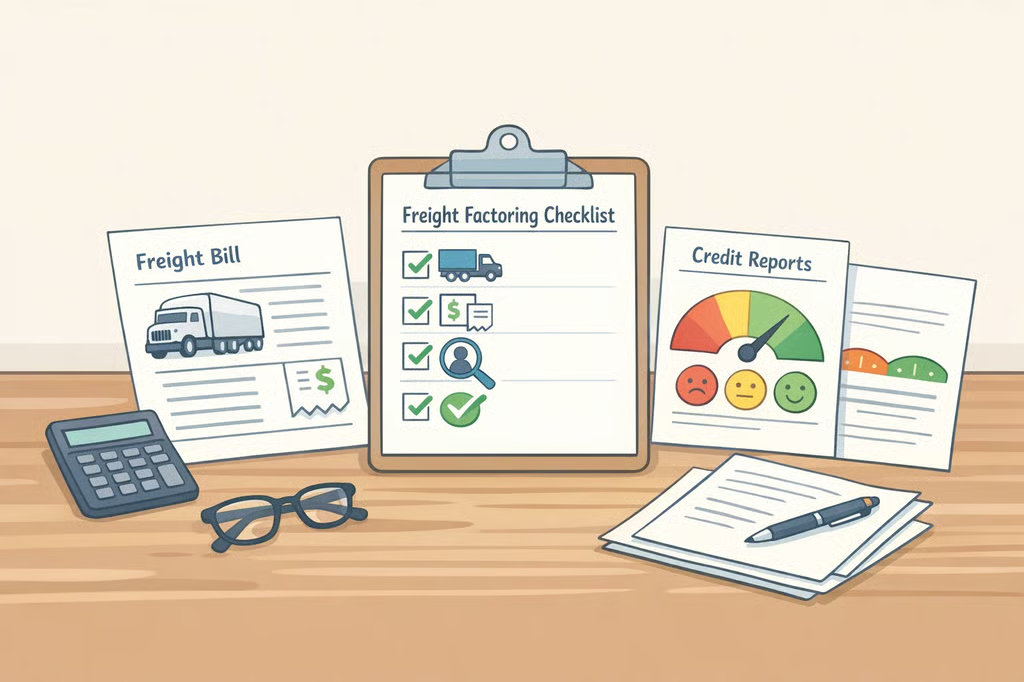
- Freight Factoring Requirements: How to Qualify Before You Apply
- The threshold requirements: what to confirm before anything else matters
- Fixable problems vs. timing questions: making the right call
- Should you apply now? A decision framework
- Three contract mechanics to check before you sign
- Where you go from here
Freight Factoring Requirements: How to Qualify Before You Apply
This guide walks through the criteria freight factoring companies evaluate during underwriting: carrier-level requirements, invoice-level documentation, and the customer-credit piece that catches most carriers off guard. By the end, you'll know whether to apply now, fix something first, or hold off entirely.
One foundational point shapes everything that follows: freight factoring companies underwrite your customers, not your company. When a factor buys your receivables, their exposure is whether your brokers and shippers will pay. A carrier with two years of messy financials but a steady lane with a major national broker can qualify. A carrier with clean books but a roster of obscure small brokers may not. That logic runs through every requirement below, and understanding it is the difference between applying with confidence and applying blind.
The threshold requirements: what to confirm before anything else matters
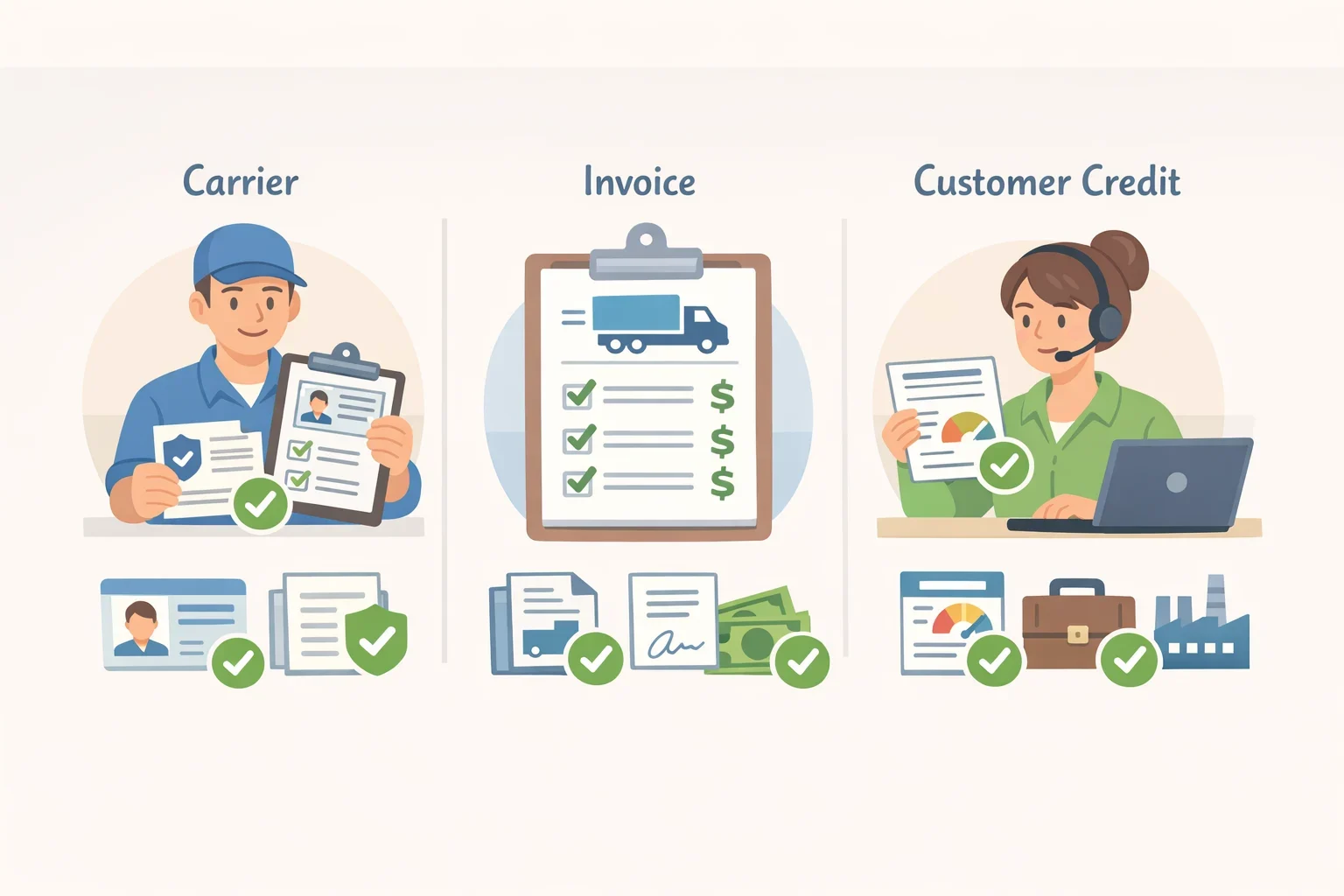
These aren't scoring criteria. Factoring companies verify each one at the start of the application and stop the process if something is missing. Walk in without these and you won't reach underwriting.
Active FMCSA operating authority, verified in the public record. Your MC number must show "Active" status in FMCSA's SAFER database. Beyond active status, ask each prospective factor directly: do you have a minimum authority age requirement, and does being close to that threshold affect pricing or terms? Providers vary, and the answer determines whether it's worth waiting before you submit anything.
Insurance naming the right legal entity. Ask each factor what coverage levels and types they require liability minimums, cargo coverage, any additional endorsements. What tends to be consistent across providers: your certificate of insurance must name your registered business entity exactly as it appears in your FMCSA filing. A name mismatch between operating authority and insurance certificate is entirely preventable and will stall an application.
Completed loads with a clean paper trail. Factoring companies buy invoices tied to freight that has already moved. Ask each prospective factor what documentation they require per invoice, but expect to need a signed rate confirmation, a bill of lading, and a proof of delivery for each load. Factors typically ask for sample invoices during the application process, and gaps in that sample are a direct signal about how you'll deliver paperwork as an ongoing client.
A properly structured business entity and a dedicated business bank account. You need a registered entity, an EIN from the IRS, and a bank account in the business name. Ask each provider what account structures they accept, but confirm before applying whether they require a dedicated business account. Commingled finances will surface during onboarding regardless.
Your customers must pass a credit check, and this is where many applications fail. Even after clearing every carrier-level item, your application lives or dies on whether your customers have verifiable credit profiles and payment histories. Established freight brokers with long track records are straightforward for factors to evaluate. Newer or less-known brokers face more scrutiny and may be declined at the invoice level even after you're approved as a carrier.
Approval doesn't mean unlimited access. A factor may approve you but only purchase invoices from certain customers, cap the volume they'll buy from any single debtor, or exclude a broker entirely. Say you run freight for three brokers: two with long payment histories, one newer operation with no verifiable track record. The factor approves you, buys invoices from the first two, and declines the third. If that third broker represents 60 percent of your monthly loads, your approved factoring line doesn't actually solve your cash flow problem. Ask each prospective factor to pre-screen your top five brokers before you fill out a full application. Most will run a check before you commit to anything.
Fixable problems vs. timing questions: making the right call
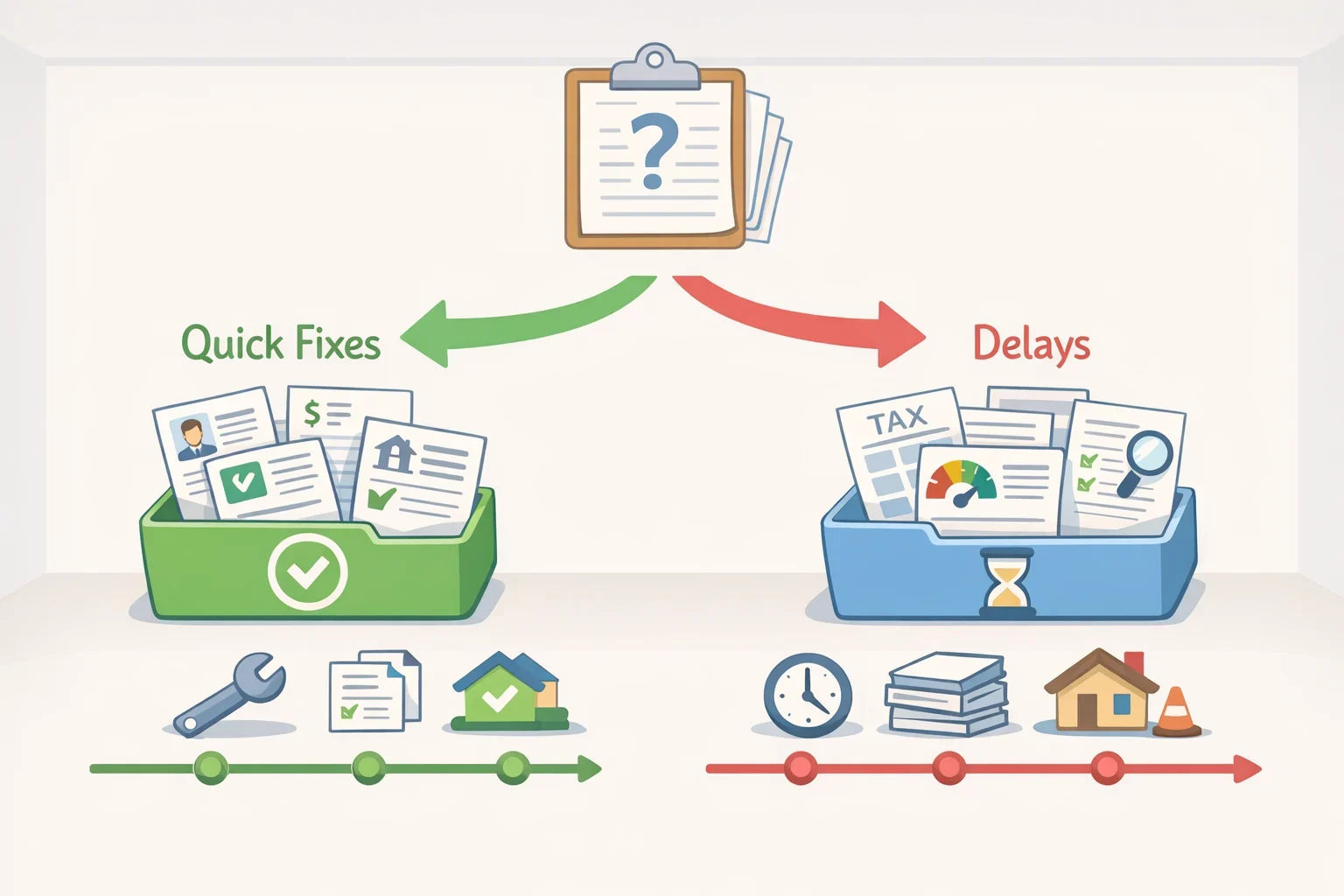
Misreading this distinction sends unprepared carriers into applications they'll lose, or keeps ready carriers on the sideline for no reason.
Problems you can usually resolve before applying:
- Name mismatches across documents. Match your legal name across SAFER, your insurance certificate, your EIN records, and your bank account before you submit anything. Recent entity restructurings cause this frequently. A call to your insurer for a certificate amendment and a visit to your state filing office usually handles it, but allow time for changes to propagate through official records.
- Incomplete BOL or POD documentation on existing invoices. Clean up your records before submitting. This is a process problem, not a structural one, and fixing it before the application saves negotiating over it during underwriting.
- No dedicated business bank account. Confirm requirements with any factor you're considering, but don't apply without one.
Problems that take weeks to months and require deliberate sequencing:
If you're facing multiple items here, work in this order. Authority age comes first because you can't accelerate the clock, only wait it out. Customer base development comes second because it requires sustained activity to build. Tax or legal issues come third because resolution timelines are unpredictable and outside your direct control.
- Authority close to or under a provider's minimum age requirement. Ask each factor directly: does waiting another 30 days change my eligibility or pricing? If yes and you're close, wait. If you're well under the threshold, ask which factors work with newer carriers and how they price that risk.
- Thin or unverified customer base. If most of your loads come from brokers with no verifiable payment history, ask prospective factors how they handle those invoices before applying. Building more load history with established brokers first gives you a stronger book and may open better terms.
- Unresolved tax liens or other public-record obligations. Ask each factor directly how open liens affect eligibility. Get any resolution documented in writing before reapplying.
Situations to verify with each provider before applying:
Some circumstances vary enough across the industry that assuming a universal outcome will lead you wrong.
- Revoked or inactive operating authority. Ask each factor whether they can work with you during reinstatement before assuming any can or can't.
- Active or recent bankruptcy proceedings. Ask each provider directly: what is your policy on active proceedings, and what do you need to see post-discharge before extending a line?
- Unresolved FMCSA safety violations or active out-of-service orders. Ask each factor how they treat open violations before submitting. Don't apply assuming either a decline or an approval.
The line between "weeks to months" and "verify first" matters because one is a timing question and the other is a qualification question. A temporary blocker isn't a permanent disqualifier. Know which you're dealing with before deciding whether to wait or walk away.
Should you apply now? A decision framework
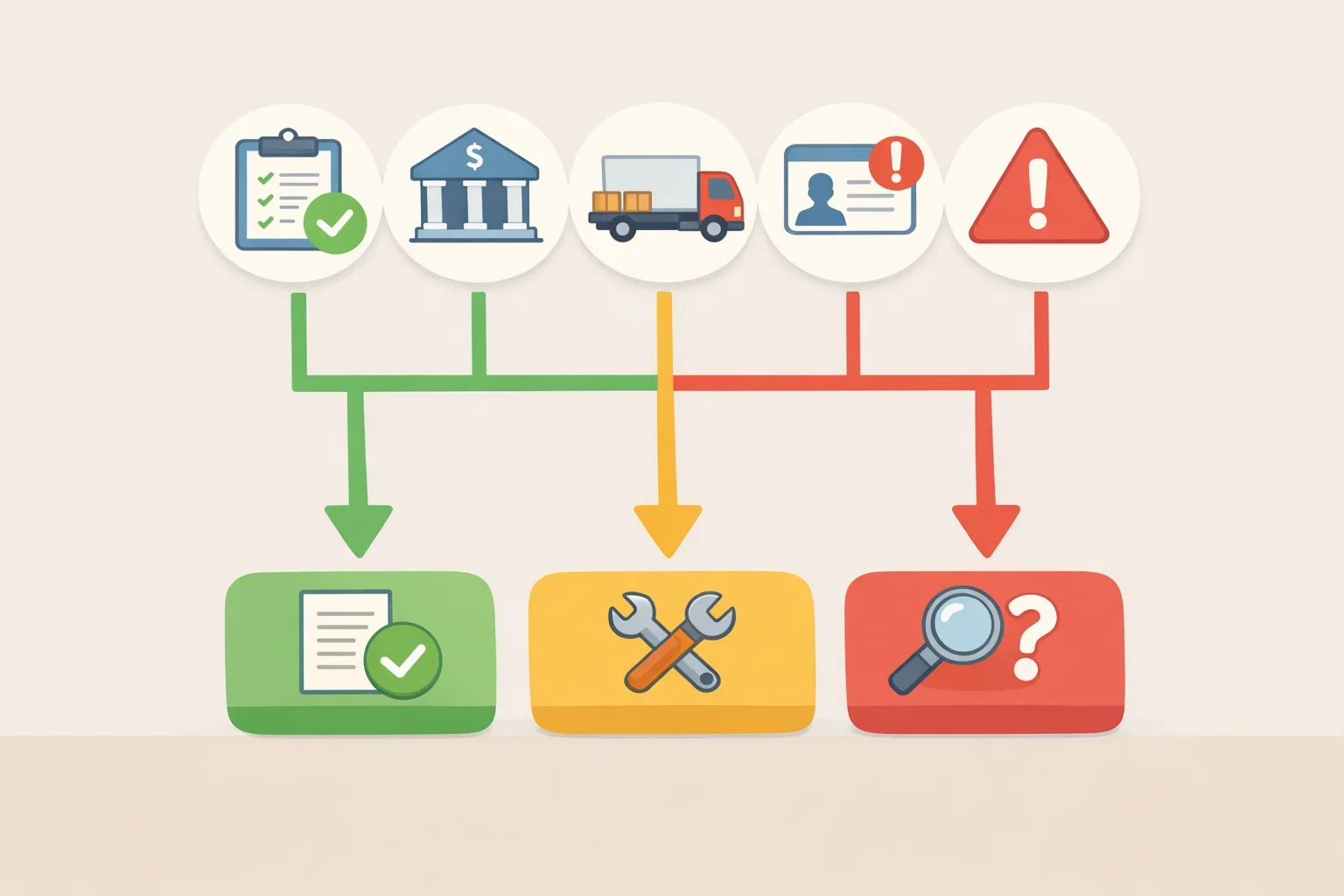
Run through these before you pull a single document together.
Apply now if all five are true:
- Your MC number shows "Active" in FMCSA's SAFER system and meets the minimum authority age your target providers require.
- Your insurance certificates are current and name your correct legal entity, and you've confirmed with each prospective factor that your coverage meets their specific requirements.
- You have completed loads with full documentation for each: signed rate confirmation, bill of lading, and proof of delivery.
- Your business has a registered entity, an EIN, and a dedicated business bank account.
- You've confirmed with at least one prospective factor which of your major customers they can approve.
Fix something first if one or two items above aren't resolved. Identify the highest-priority gap and close it before submitting. Applying with a known problem doesn't speed anything up; it moves the problem to underwriting, where you have less control over the outcome.
If you're declined, ask specifically why before doing anything else. Documentation gaps can usually be corrected and a new application submitted quickly. Customer credit failures are more instructive: ask which customers were declined, because you may be able to factor invoices from approved customers immediately while building more history with stronger brokers over time. A decline from one factor is worth testing against one or two others. Underwriting standards differ across the industry, and one no is not a market-wide verdict.
Three contract mechanics to check before you sign
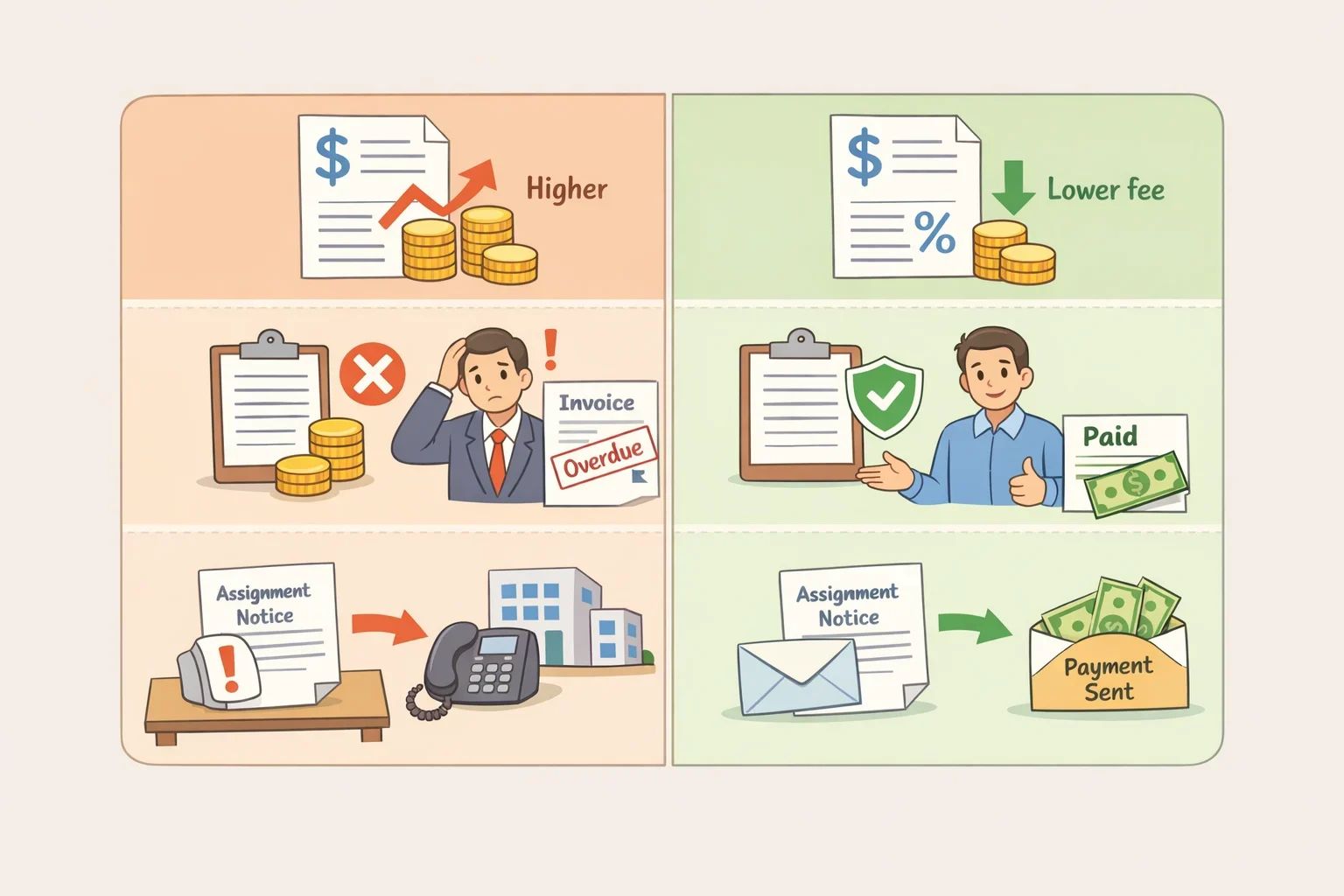
Qualification gets you to an offer. What's in the contract determines whether that offer actually solves your problem.
Fee structure by payment window. Before signing anything, ask the factor to apply their full fee schedule to a representative invoice from your actual book across 30-day, 45-day, and 60-day payment scenarios, in writing. That calculation tells you more about real cost than any headline advance rate. Slow-paying customers, even creditworthy ones, can make a nominally attractive rate expensive quickly when fees compound across extended payment windows.
Recourse vs. non-recourse. In recourse arrangements, you buy back an invoice if your customer doesn't pay. Non-recourse shifts more of that default risk to the factor, but ask each provider to define in writing exactly what triggers protection and what doesn't. Many non-recourse agreements cover customer insolvency but not disputed invoices or billing errors. Get the definition, not just the label.
Notice of assignment. Most factoring agreements require your customers to pay the factoring company directly rather than paying you. Before signing, ask the factor to walk through the notification process step by step: what language goes to your customers, when it goes out, and what happens operationally if a customer pays you instead. That last scenario creates friction. Knowing the procedure in advance prevents it from becoming a problem mid-relationship.
Where you go from here
Check your MC number in FMCSA's SAFER system, pull your three most recent invoice packets and verify each has a signed rate confirmation, bill of lading, and proof of delivery, then contact one or two prospective factors and ask them to pre-screen your top brokers before you complete a full application.
If gaps remain, address fixable ones in priority order and build load history with established brokers if your customer base is thin.
