


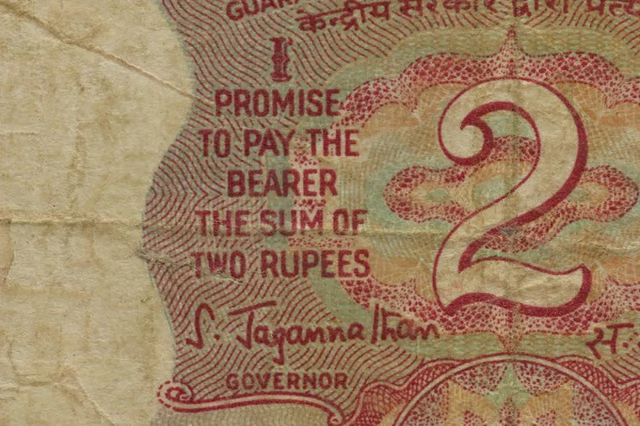
A promissory note, or a note of pay, is a written, stamped, dated and signed legal document used when two parties are involved in a loan transaction. The document contains an unconditional promise made by the loan-maker to pay back the money to the loan-giver either on demand or at a future date as specified in the note. Promissory notes do not allow for repayments via a third-party or through non-monetary services.
.
According to the Sections 1916 and 1917 of the California civil code, unless the rate and the period of interest are explicitly stated in the promissory note, the loan-maker should pay at an annual simple interest rate of seven percent on the principal amount of loan taken. Further, according to the Section 1918, if the two parties in a loan transaction do agree and mention the interest rate in the promissory note, the loan-maker must continue to pay interest at the aforementioned rate until and unless he challenges it in a court of law.
Compound interest, also referred to as "interest on interest," is the interest paid not just on the principal amount but also on the previously accumulated interest. Simple interest, on the other hand, is the interest paid just on the principal amount as it appeared on the first date of the loan transaction. Simple interest does not merge with principal and therefore the amount paid as interest does not become part of the base for the computation of future interest.
According to the Section 1919 of the California civil code, when the parties involved in a loan transaction do arrange for an interest rate explicitly mentioned on a promissory note, if the aforementioned interest is not paid punctually, the interest then becomes part of the principal. In other words, if the loan-makes regularly fails to pay mutually agreed simple interest on the loan, the interest thereafter to be paid on the loan converts into a compound interest.
It is not always clear, under California law, when and after how long does the interest on the loan considered as not being paid "punctually." However, from two court cases, Page v. Williams and Dewey v. Bowman, it is often presumed that if a loan-maker fails to pay simple interest on the principal for three consecutive or for three separate months, the interest to be paid thereafter converts into compound interest.
