

Founder Fired for Ignoring Return-to-Office Policy Sues for M
A co-founder fired for ignoring a return-to-office policy he personally signed is now seeking at least $30 million in federal court and arbitration, arguing the termination was cover for a forced equity buyout his partners had already failed to negotiate. William Nieporte, who co-founded Bramshill Investments in 2012 and helped build it into an $8 billion fixed-income asset manager, was let go after missing the July 5 compliance deadline attached to a five-day RTO mandate that bore his own signature, according to WebProNews.
Four years on, the dispute has landed in both federal court and a separate arbitration proceeding, WebProNews reported this week. What started as a workplace attendance dispute has become a test of whether a facially neutral company policy can serve as the trigger for a forced share sale targeting a minority founder.
The ownership structure that made this termination high-stakes

To understand why a missed office deadline led to a $30 million lawsuit, the equity math comes first. Bramshill's parent entity, Ironmen Holdings, divided ownership unevenly among the three co-founders: DeGaetano held 48 percent, Selver held 40 percent, and Nieporte held 12 percent, per WebProNews.
That minority stake carried a significant condition. Ironmen Holdings included a provision requiring any shareholder terminated for cause to sell their stake, the same reporting shows. A successful "for cause" finding would accomplish two things simultaneously: remove Nieporte from day-to-day operations and compel him to exit the equity entirely. The firing, if it holds up legally, is also a forced share sale.
Nieporte's complaint alleges the sequence was not coincidental. His lawsuit claims his co-founders attempted to buy out his stake in 2021, before the five-day return-to-office mandate was ever drafted, as ISACNet reported. Nieporte alleges the RTO policy was introduced after that negotiation failed, and was then enforced specifically against him as the mechanism for achieving what a negotiated buyout could not. Those allegations are contested and unproven; courts and arbitrators will weigh them. But they reframe the central question. This is not primarily a dispute about office attendance. It is a dispute about whether a company-wide attendance policy, applied to a co-founder with a forced-sale clause attached to his equity, can double as a governance mechanism for removing a minority shareholder.
Return-to-office lawsuit: what each side is actually arguing

In early 2022, all three co-founders signed an internal email directing staff to report to one of Bramshill's three offices five days a week, with a July 5 deadline, per WebProNews. Nieporte stayed remote. After the deadline passed, Selver and DeGaetano sent a termination letter.
The letter stated Nieporte had "willfully and deliberately failed to report to 'in-person' work," WebProNews reported. That phrasing matters. "Willful and deliberate" is a high-conduct standard, and framing the termination that way was a deliberate legal choice, not casual wording. A routine performance issue does not carry the same weight under a "for cause" clause as intentional misconduct.
DeGaetano followed with a separate note: "We have both junior and senior employees commuting over one hour each way to work, and yet you feel this policy doesn't apply to you," according to WebProNews. Bramshill's implicit argument is one of basic fairness: Nieporte co-signed the directive, the deadline came and went, and he simply did not comply with a rule he had imposed on everyone else.
Nieporte's attorney, Matthew Press of Press Koral LLP, told The Wall Street Journal that non-compliance with the directive did not meet the agreements' threshold for "cause," and that the policy "did not validly apply to Mr. Nieporte, who was an owner and manager of the company," as reported by WebProNews. That argument cuts at the foundation of Bramshill's position. "For cause" provisions are commonly drafted with employees in mind. When the same language appears in a shareholder agreement and the target is a founder-owner, the question of whether it applies the same way, and what it requires to trigger a compulsory share sale, is genuinely unsettled legal ground.
Nieporte also claims the policy never applied to him in the first place, ISACNet reported. His complaint raises a separate procedural challenge: the termination notice was defective because it was not delivered by hand, fax, or mail, the methods specified in the governing agreements, per ISACNet. Notice requirements in employment and shareholder agreements are not formalities. When they are contractually specified, failure to follow them can void a termination even when the underlying conduct is not disputed. That argument gives Nieporte a second line of attack independent of the "for cause" question entirely.
The federal lawsuit against ADP TotalSource

Two months ago, Nieporte expanded the dispute by filing a federal lawsuit against ADP TotalSource, the HR outsourcing firm that managed Bramshill's employment infrastructure and processed his termination, according to WebProNews. He continues arbitration separately against Bramshill, Ironmen Holdings, Selver, and DeGaetano.
ADP denied wrongdoing. A company spokesperson told The Wall Street Journal it had complied with all applicable laws and would defend itself vigorously, per WebProNews.
Naming ADP materially expands the scope of the dispute. HR outsourcing arrangements often create ambiguity about which entity bears employer-side legal obligations: the client company that directs the employment relationship, or the provider that handles payroll, benefits, and formal employment documents. When a third-party HR platform processes a termination, the question of whether it is acting as a co-employer or merely as an administrative agent is not always cleanly settled by contract language. A federal court ruling on that boundary in a case involving a founder-shareholder with a compelled-sale clause attached to his equity would carry practical weight beyond Bramshill alone.
The precise theory of liability against ADP, whether Nieporte names it as a co-employer, as an actor that executed an unlawful instruction, or on some other basis, is not yet detailed in publicly available filings.
Where the case stands now
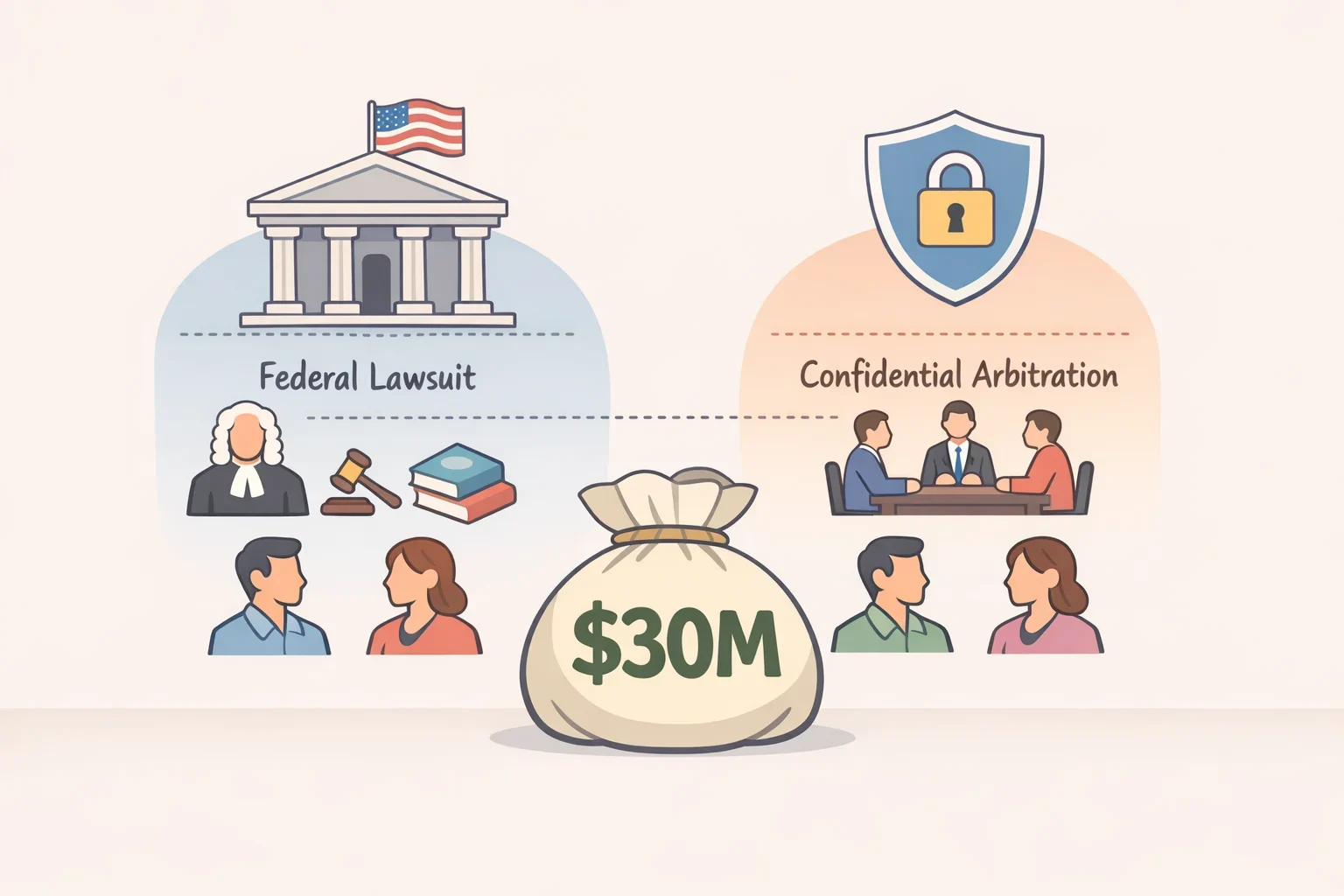
Two proceedings are running in parallel. The federal lawsuit against ADP TotalSource, filed two months ago, is the more publicly observable track. The arbitration against Bramshill, Ironmen Holdings, Selver, and DeGaetano continues separately; arbitration is confidential by design, so any rulings in that proceeding are unlikely to become public.
Nieporte is seeking at least $30 million in lost earnings, profit distributions, and the assessed value of his stake in a firm managing $8 billion in assets, per WebProNews. Whether that figure reflects a documented valuation or an opening position in a negotiation is not established by available reporting. It does signal how much is at stake when a forced equity exit is embedded in the termination itself.
Three issues surface clearly from the public record, relevant to any organization where founder equity and employment governance overlap. Founder titles do not automatically create exemptions from company-wide policies, but they may create a legally distinct relationship to those policies, particularly when shareholder agreements and forced-sale clauses are in play. "For cause" language in operating agreements and shareholder documents warrants review alongside employment terms; when the two interact with compelled-sale provisions, the consequences of a termination reach far beyond salary. And procedural requirements in those agreements, including notice delivery methods and timing, can become decisive if the underlying conduct is contested.
The federal case against ADP TotalSource is the proceeding most likely to yield public guidance. Any judicial ruling on the scope of HR outsourcer liability in a termination dispute involving a founder-shareholder will be worth watching closely. For now, the core dispute hinges on a question neither side has yet resolved: whether missing a deadline on a policy you signed constitutes "cause" when the person fired is also a part-owner of the company, and the consequence is not just termination but the loss of an equity stake four years in the making.
